When is the Summer solstice? The longest day of the year is soon
The summer solstice has long been greeted as a time for rituals to gather luck, tell the future and ward off evil
Whether cities or villages, many communities across Europe spend the day and night of June 24 celebrating Midsummer. Congregating around bonfires, or sometimes maypoles, sporting handwoven wreaths of wildflowers or oak leaves, they’ll sing, jump, dance, eat, drink, catch up and celebrate the arrival of the longest day of the year. As a scholar of folklore, I have been to Midsummer celebrations in Finland, Sweden, Norway, Denmark, Estonia and Lithuania, and I am endlessly in awe of people’s fervent commitment to the holiday and evident enjoyment of it.
From the Mediterranean to Scandinavia and from France to Poland and beyond, Midsummer goes by many names, including the Italian “Festa di San Giovanni Battista” and the Swedish “Midsommar.” It’s “Leedopäev” in Estonia, “Juhannus” in Finland, and “Mihcamárat” for the Sami, the Indigenous people of Scandinavia. Celebrations mark the summer solstice, which takes place in the Northern Hemisphere around June 21.
open image in galleryAt the summer solstice, the Sun ‘stands still’ – the meaning of the Latin solstice – and begins its progression back toward the south (Getty Images)Each morning from the time of the winter solstice to the summer solstice, the sun rises a little farther to the north. As the sun climbs higher in the sky, shadows grow shorter and days grow longer. At the summer solstice, the Sun “stands still” – the meaning of the Latin solstice – and begins its progression back toward the south.
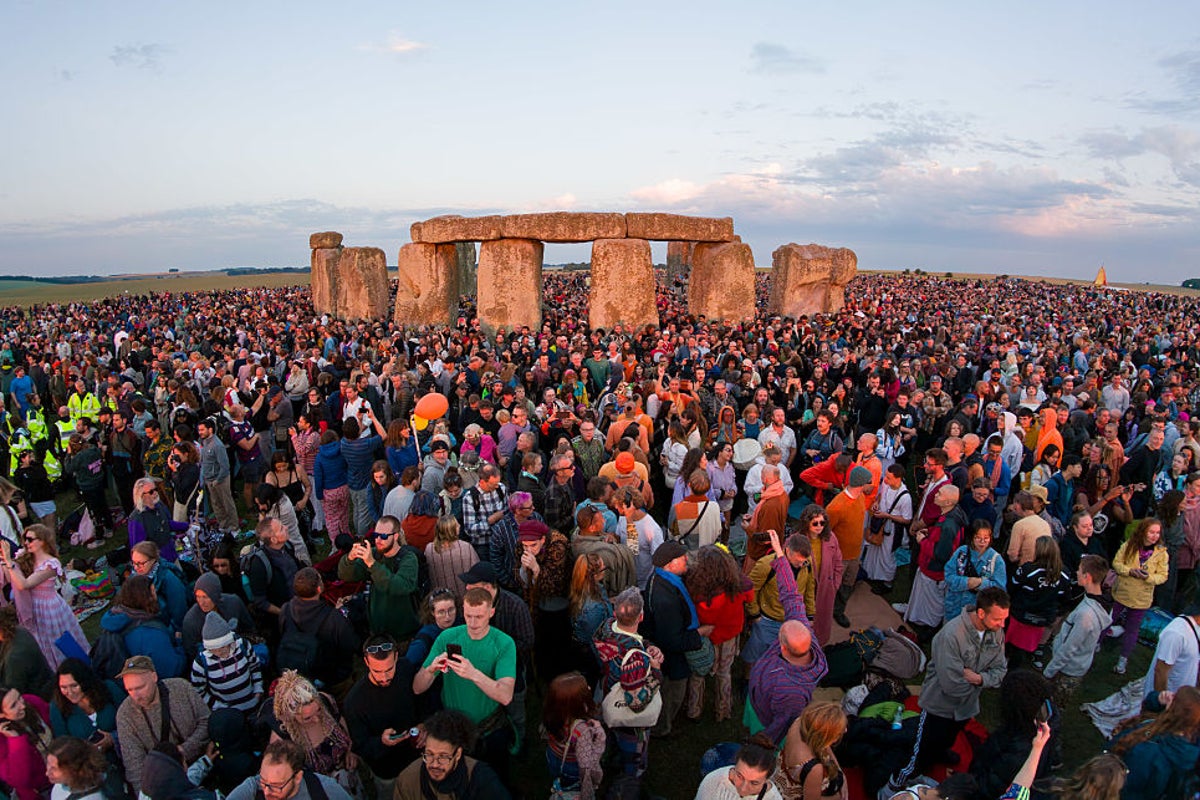
Days shorten, shadows lengthen, and the cold and dreariness of winter return.Europeans across the entire continent have noted this simple and inexorable cycle for millennia. Neolithic monuments such as Ireland’s Newgrange and England’s Stonehenge, both of which date from around 5,000 years ago, were built to mark solstices.
Lighting the bonfireFrom the Mediterranean to the northern peripheries of Europe, the summer solstice has long been greeted as a time for rituals to gather luck, tell the future and ward off evil.In Germany, northeastern France and many parts of Scandinavia and the Baltic, people still build elaborate bonfire pyres to light in the evening and tend long into the night. According to folk belief, stepping or leaping over the flames brings love and fertility, while the height of the flames predicts the coming year’s harvest.
Traditionally, many Europeans gathered dew, herbs or leaves on Midsummer eve, which was reputed to ensure health, beauty and good fortune. Some brought their cattle close to bonfires to breathe in the smoke, or scattered fields with ashes the next day. Although people today generally regard these beliefs as quaint reminders of the past, often they avidly participate, just in case – tying them to forebears centuries or even millennia in the past.
open image in galleryTraditionally, many Europeans gathered dew, herbs or leaves on Midsummer eve, which was reputed to ensure health, beauty and good fortune (Getty Images)Pagan, Christian and secularMany of the names for the holiday, such as the Danish “Sankt Hans Aften” or Icelandic “Jónsmessunótt,” are connected with John the Baptist, the Christian saint whose birthday is celebrated June 24. Where Jesus’ birth is commemorated around the time of the winter solstice, the Bible describes his cousin St. John being born precisely six months earlier, at the height of summer.
The interest in this connection between Jesus and John explains why the holiday takes place on June 24 – or in some countries, on the nearest Saturday – rather than on the actual solstice.Medieval Christian authorities did not always relish the “pagan” celebrations of the day and occasionally decried peasants’ dancing, singing and other customs. During the 16th century’s Protestant Reformation, celebrations of Catholic saints’ feast days were suppressed, but Midsummer lived on as a secular holiday.
About the authorThomas A. DuBois is a Professor of Scandinavian Studies, Folklore, and Religious Studies, University of Wisconsin-Madison. This article was first published by The Conversation and is republished under a Creative Commons licence.
Read the original article.In places where Protestants and Catholics overlapped, such as the Netherlands, celebrating St. John’s eve became an emblem of Catholic identity.
The Feast of St. John is celebrated as the “fête nationale” of the Canadian province of Québec in part to differentiate the province from the culture of its English Protestant neighbors.One of the most iconic images of Swedish celebrations of the day, Anders Zorn’s 1897 painting “Midsommardans,” or “Midsummer Dance,” reflects 19th-century anxiety that beloved traditions would disappear.
Zorn himself paid for the erection of the maypole depicted in his painting, seeking to preserve the picturesque custom in the region of rural Sweden where he lived.Yet Zorn’s fears were unfounded. Much has changed, but Europeans remain appreciative of the simple and unchanging rhythms of the natural world, including the coming and passing
Đọc thêm từ Thế giới
被害者の名前が書かれた文書を被告に手渡す 広島県警が職員を処分
電車内で10代の女性2人の体を触ったとして、広島県迷惑防止条例違反の罪で起訴された県警科学捜査研究所職員の男(59)に対し、県警の職員が被害者の名前を記した文書を誤って渡していたことがわかった。県警は情報の取り扱いが不適切だったとして、内規に基づいて処分した。 捜査関係者などによると、昨年8月に男が起訴された後、県警職員が男の休職手続きのために留置施設で面会した際、起訴内容を写した文書を男に手渡した。文書には、本来明かすべきではない被害者2人の名前が記されていたという。 外部からの指摘を受け、県警は文書を回収し、被害者側に謝罪の意向を伝えた。名前が男に伝

KHNP CEO reviews Dukovany project in Czech Republic
State-run Korea Hydro & Nuclear Power (KHNP) CEO Kim Hoe-chun met with Czech industry officials on Thursday (local time) to review progress on the Dukovany Nuclear Power Station project, marking one year since the two sides signed a landmark construction contract. During his two-

LNG leak in southern Seoul forces 130 to evacuate
A liquefied natural gas leak on Thursday in southeastern Seoul's Songpa District prompted the evacuation of about 130 residents. No injuries were reported. According to fire authorities, a report of a gas leak was received Tuesday at around 2:46 p.m. near Exit 4 of Hanseong Baekj

S. Korea conveys concern to China over N. Korea's silence on denuclearization
The South Korean government reportedly raised concerns with China over growing speculation that Beijing is tacitly condoning North Korea's nuclear weapons, a perception fueled by China's recent silence on denuclearizing the Korean Peninsula. According to South Korea's Ministry of