We talk with astronaut Michael Foale about the 1997 Space Station Mir crisis: 'He took all the blame of the collision on his shoulders'
'I believe that we, as a crew, saved space station Mir that day'
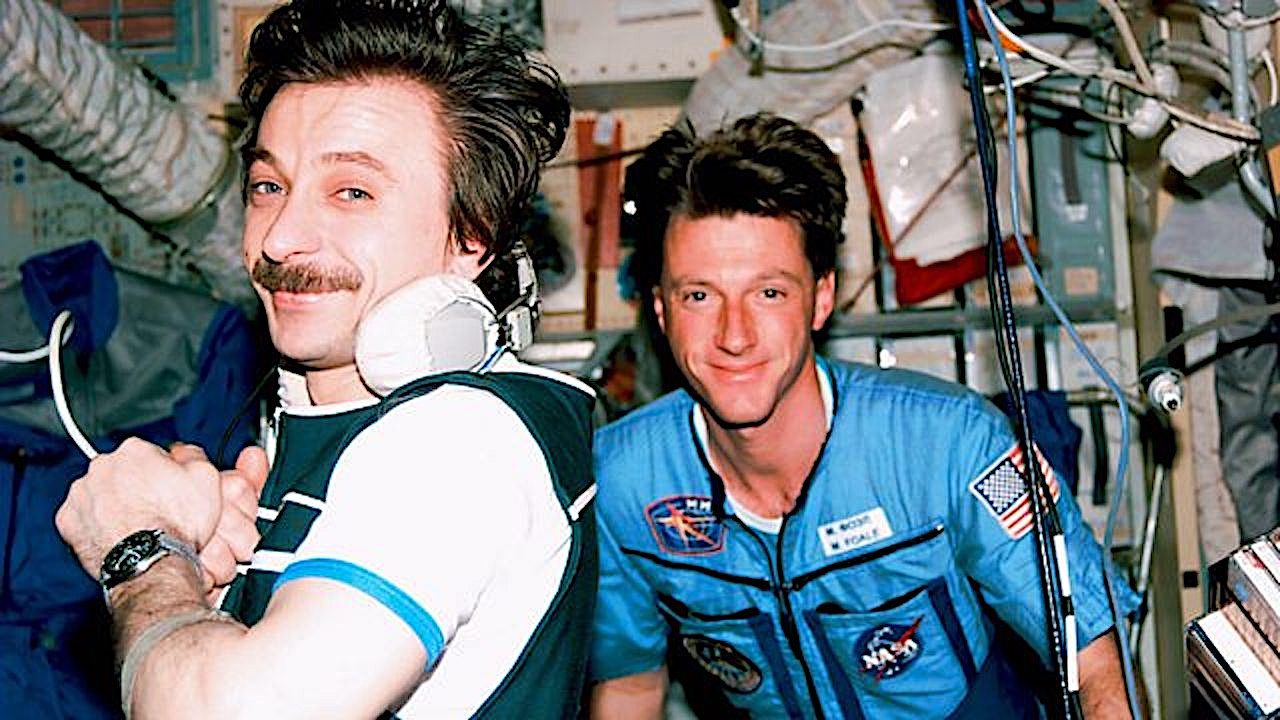
Skip to main content Click for next article Copy link Facebook X Whatsapp Reddit Pinterest Flipboard Email Share this article 0 Join the conversation Follow us Add us as a preferred source on Google Newsletter Subscribe to our newsletter ONCE UPON A TIME IN SPACE | Clip | Fix the Ship - YouTube Watch On All systems are go! PBS just launched the second episode of its "Once Upon a Time in Space" miniseries on Tuesday, titled "The Russian Thing," and we’ve got an exclusive clip from the harrowing chapter that focuses on near disasters aboard the Space Station Mir in 1997.In addition to the video, we’re also proud to share an exclusive interview with NASA's celebrated British-American astronaut Michael Foale, who is featured prominently in the new segment regarding the infamous cargo pod collision on Mir, which caused a decompression incident that became a life-threatening crisis.
Hailing from British filmmaker James Bluemel and his crew that delivered the award-winning "Once Upon a Time in Northern Ireland," "Once Upon a Time in Space" is a 4-part exploration of human spaceflight. Its weekly episodes trace pivotal events in spacefaring history via the personal experiences of astronauts, cosmonauts, and loved ones left on Earth from the birth of the Space Shuttle program to the blossoming of today’s commercial spaceflight industry.Latest Videos FromSpaceView moreWatch full video here: Preview - Once Upon a Time in Space - YouTube Watch On "James Bluemel is a very perceptive director, and he was different from others that have interviewed me," Foale tells Space."
What I loved about his method was he would dig up clips from our training or at different points when I was a brand new astronaut, looking really young and had a surfer boy haircut. I love windsurfing. He would dig up clips I don't know where from.
And then he'd show it to you, and then he'd say, 'What do you think?'"Foale — a distinguished veteran of six space missions who retired in 2013 — takes us back to that day of May 25, 1997, when a manual docking maneuver caused an unmanned Progress cargo ship to collide with Mir, ripping a large hole in the Russian space station’s Spektr module.The crew’s valiant attempt to halt the pressure leak and save the station is like something straight out of a Hollywood thriller.
With only 23 minutes of oxygen left, Foale and cosmonauts Vasily Tsibliev and Alexander ‘Sasha’ Lazutkin were able to repair the damage and stop the tumbling spacecraft from spinning wildly out of control."The root cause of the accident was trying to save money," he explains. "And the root cause was an attempt to do a manual docking from a large distance longer than any cosmonaut or astronaut does a manual docking from and doing it without the radar.
The radar was built in Ukraine and cost $2 million in that timeframe. And the Russian managers did not want to pay Ukraine $2 million."So someone in the Energia corporation — they're the guilty company — decided they would try and get this crew at the last minute to try and do a manual rendezvous and docking without the radar from about a six-kilometer starting point.
And that test was with a Progress we'd already filled up with trash and was meant to be de-orbited into the Pacific Ocean. Before it was going to be de-orbited finally, it was going to do this test." (Image credit: PBS)Unfortunately, that test went horribly wrong due to Vasily Tsibliev not being able, based on measurements he could make in real time, to determine the exact closing velocity of the Progress."
He couldn't ascertain distance very well, but you need the distance first, and then you need to divide by time to get the velocity,” notes Foale. “That was not possible in that situation and never attempted again. It caused a much higher velocity than Vasily could extinguish using the one thruster set that were turned on the Progress."
So it bounced off, literally bounced off after crumpling part of the Spektr module and bending one of the solar arrays. The joint cracked at the base of the solar array into the module, and that's where the unseen hole is or was. And that's where the air was leaving from.
It was a multiple hit that caused it to float away. And we were told as a crew about three days later, because we asked what had happened to it. They said, 'Well, engine was capable of being fired.
It was capable of reorienting itself, and it de-orbited into the Pacific.'" The Soviet space station Mir before being de-orbited in 2001 (Image credit: NASA)In the aftermath of the collision, an adapter was sent up to try and connect power back from the Spektr module into the Mir system."Vasily and Sasha were planned to do an internal spacewalk into the Spektr module to get to those cables that Sasha and I had had to disconnect to save the station," Foale adds.
"They were going to go back in during an internal EVA. Vasily, because of the stress of the event, didn't pass the medical test done before the spacewalk, and they wire you up for a
Đọc thêm từ Khoa học

New model maps how social media users repeatedly spread misinformation
People who receive information on social media play a greater role in the spread of misinformation than research has acknowledged, according to research published in the International Journal of Enterprise Network Management. The researchers argue that efforts to tackle "fake new

Cameras attached to whale sharks capture krill chases never witnessed before
Whale sharks (Rhincodon typus)—the world's biggest fish—are one of the most charismatic marine species. They connect with the hearts of anyone lucky enough to encounter them, making people deeply curious about their lives and invested in their conservation.

China evacuates 340,000 people as Typhoon Noul approaches
Authorities have evacuated more than 340,000 people and suspended work and rail services as Typhoon Noul approaches southern China, with flight cancellations announced in Hong Kong.

Spain fights to 'save lives' as wildfire evacuees shelter in Madrid
Spain's Prime Minister Pedro Sánchez said Saturday firefighters were working to "save lives" in the blazes raging west of Madrid, as authorities said a separate fire in the east killed one person.