Wall Street’s newest short desk is a blockchain
When SpaceX went public, the only place most of the world could short it was Hyperliquid, where a perpetual future tracked the IPO of the decade tick for tick, and a whale ran a $14 million leveraged short no brokerage…

Share Link copied When SpaceX went public, the only place most of the world could short it was Hyperliquid, where a perpetual future tracked the IPO of the decade tick for tick, and a whale ran a $14 million leveraged short no brokerage would have offered. Equity perps are the first crypto product Wall Street cannot ignore, and regulators cannot place, and this is the audit of what they actually are. Summary Hyperliquid, the dominant on-chain derivatives venue with roughly 70% of decentralized perpetuals volume and around $1.
3 billion in annualized fees, now lists perpetual futures on stocks, with its SpaceX contract as the breakout case. The SPCX perp traded the IPO of the decade before, during, and after the listing, ran to a $228.74 high alongside the stock’s $225.
64 peak, tracked its 48% collapse, and hosted positions like a 10x-leveraged $14 million short paired with a 40x $60 million Bitcoin short, structures no retail brokerage offers. Equity perps deliver what the equity market rations: 24/7 trading, high leverage, short exposure without locates or borrow fees, and access for the global majority locked out of US brokerage accounts, all against an oracle price and a funding rate instead of shares. The product’s honesty requires its limits: holders own no equity, no dividend, no claim, only a synthetic exposure whose integrity depends on oracle quality and venue solvency, on platforms mostly outside US jurisdiction.
The regulatory placement is unresolved by design: synthetic equity exposure with no share changing hands sits between the SEC’s securities world and the CFTC’s derivatives world, on infrastructure neither reaches, and the CLARITY-era jurisdiction map does not cover it. The most interesting trade of June was not in a stock. When SpaceX completed the largest IPO in history and its shares began their 48% descent, an anonymous trader on Hyperliquid, the blockchain derivatives venue, was running a combined position no prime broker would have blessed and no retail app could have executed: a $60 million Bitcoin short at 40x leverage paired with a $14 million short on SPCX at 10x, a pure bet on the deflation of the year’s twin euphorias, placed on rails that never close, require no borrow, and asked no questions.
The instrument making it possible, the equity perpetual future, is the crypto industry’s quiet invasion of the stock market: a synthetic contract that tracks a share price via oracle, settles in stablecoins, charges longs or shorts a funding rate to keep the peg, and trades around the clock at leverage American brokerages reserve for institutions, on venues most of the world can reach with a wallet. Hyperliquid’s SPCX contract, born before the IPO priced and still trading through the stock’s every convulsion, is the product’s proof of concept and its perfect case study, and this piece uses it as one: what equity perps actually are, what they genuinely fix, what they quietly are not, and why the regulatory map, freshly redrawn for crypto by the CLARITY era, has no square for them at all. You might also like: ARK Invest buys $251K of BitMine, Solana ETF The machine: how a stock trades without shares An equity perpetual is three mechanisms in a trench coat, and each deserves one honest paragraph.
The first is the oracle. No share of SpaceX exists anywhere in the system; the contract’s reference is a price feed, assembled from the listed market’s data during exchange hours and from the perp’s own supply and demand when Nasdaq sleeps. This is the design’s power and its softest point in one: the feed makes the synthetic possible, and every question about the product’s integrity is ultimately a question about the feed, its sources, its manipulation resistance, its behavior when the underlying halts, gaps, or, as with SPCX in its lockup-shadowed churn, moves violently on thin news.
Perp venues have run oracle machinery for crypto assets for years at scale; equities add wrinkles crypto never had, official closes, halts, corporate actions, and the young history of equity perps includes the learning curve those wrinkles imply. NEW: Hyperliquid HIP-3 sees $3.1B cumulative volume in SpaceX pre-IPO trading pic.
twitter.com/gt9gsqJQ6U— crypto.news (@cryptodotnews) June 18, 2026 The second is the funding rate, the elegant trick that replaces ownership.
Because nothing forces a perp’s price toward the stock’s, the contract pays a periodic transfer between longs and shorts; whichever side is heavier pays the other, so deviation from the reference price becomes expensive and arbitrage pulls the peg tight. The funding rate is also the product’s honest price tag: holding a leveraged equity view costs whatever the crowd on your side must pay, which in euphoric stretches, SPCX’s first week, say, made long exposure meaningfully expensive, a cost structure entirely unlike owning shares and closer to a rolling options position. Traders who read funding as information, crowding, sentiment, squeeze risk, get a signal
Đọc thêm từ Tiền số / Crypto
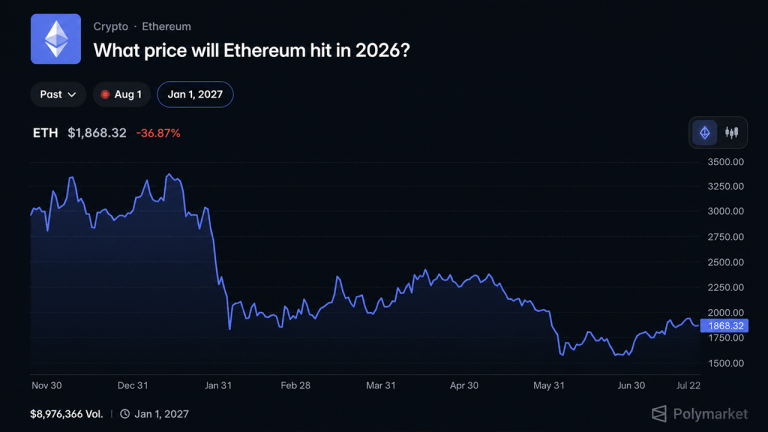
Polymarket Bettors Give Ethereum Just a 17% Shot at Reaching $3,000 in 2026
Traders on Polymarket and Kalshi are staking millions of dollars on where ethereum’s price lands before the end of 2026, with the market split almost evenly on whether the token hits $1,000 or $3,000 first. Ethereum traded near $1,860 on Saturday, July 25, down from a recent high
Why has Micron stock crashed 25% in the past month
Micron Technology (NASDAQ: MU) has suffered a sharp correction over the past month, with shares falling about 25%. Notably, MU … Continue reading The post Why has Micron stock crashed 25% in the past month appeared first on Finbold.
Strategy needs to monetize BTC after buying time with digital credit framework, Galaxy Research
Alex Thorn, the head of firmwide research at Galaxy Research, shared Galaxy’s analysis on X, adding his voice to the debate regarding Strategy’s newly announced Digital Credit Capital Framework. The new rules have sparked a debate about whether or not they will solve the company’

Trump ties Saudi nuclear deal to Abraham Accords, adding new wildcard to Middle East diplomacy
Trump says US-Saudi nuclear deal won't proceed unless Saudi Arabia joins the Abraham Accords, adding geopolitical complexity with macro market The post Trump ties Saudi nuclear deal to Abraham Accords, adding new wildcard to Middle East diplomacy appeared first on Crypto Briefing