Virtuals Protocol integrates Wake as intelligence terminal for Base
Wake's integration could democratize token risk assessment, reducing information asymmetry but may lead to over-reliance on automated analysis. The post Virtuals Protocol integrates Wake as intelligence terminal for Base appeared first on Crypto Briefing.

Virtuals Protocol integrates Wake as intelligence terminal for Base The new onchain tool scores tokens for safety and flags early signs of collapse across the Base network Share Add us on Google by Editorial Team Jun. 24, 2026 If you’ve ever aped into a freshly launched token on Base only to watch the developer dump their bags thirty minutes later, Wake wants to be the tool that saves you from yourself. The onchain intelligence terminal, launched through Virtuals Protocol’s fair launch mechanism, is designed to evaluate Base tokens across multiple safety dimensions and flag exit risks before they become catastrophic.
Instead of trusting a project’s vibes and a Telegram group’s enthusiasm, Wake runs deployer history, contract security, liquidity health, market dynamics, and social indicators through its analysis engine, then spits out a risk assessment. What Wake actually does Wake operates through several core modules: DEX Radar, Pulse Engine, and Exit Detector. Together, these components monitor the Base ecosystem and surface signals that would take a human analyst hours to piece together manually.
The Exit Detector is where things get particularly interesting. Wake flags exit risks with severity scores in real time, categorizing threats like “DEV_DUMP MEDIUM” or “SNIPER_EXIT + TOP10_DISTRIBUTION CRITICAL.” In English: it watches for patterns that historically precede a token’s value cratering, whether that’s developers selling their holdings, early snipers cashing out, liquidity being pulled, or whale-heavy holder distributions shifting.
Advertisement Since launch, Wake has indexed over 23,847 Base contracts and processed more than 1.28 million signals. The terminal runs on a pay-as-you-go model.
Users top up their accounts with USDC or ETH and burn through credits as they query the system. New wallets get five free credits to kick the tires. The tokenomics angle Wake allocates 50% of its terminal revenue to buying back its native token, $WAKE, with the remaining 50% flowing to its treasury.
If the terminal generates meaningful revenue from users paying for intelligence queries, half of that revenue creates consistent buy pressure on $WAKE. The other half funds ongoing development and operations. Wake’s contract address is 0x90f0039850c70Bb73416D6A118C7D3C63366Ce8D for anyone wanting to verify on-chain.
Why Virtuals Protocol matters here Virtuals Protocol is the platform through which Wake launched. Virtuals is a decentralized platform built for launching and co-owning autonomous AI agents on the Base network, with VIRTUAL as its utility and liquidity token. The protocol already powers thousands of AI agents on Base.
Wake represents a specific category within the Virtuals ecosystem: AI-powered market intelligence. Rather than a general-purpose chatbot or trading bot, Wake is narrowly focused on risk assessment for token launches. The fair launch mechanism through Virtuals is also notable.
Fair launches, where tokens are distributed without insider allocations or venture capital pre-sales, have become a preferred distribution method in the current cycle for projects that want to signal alignment with retail participants rather than institutional backers. For investors and traders operating on Base, Wake addresses a specific pain point: the information asymmetry between token deployers and buyers. Deployers know their own intentions.
Buyers are guessing. A tool that analyzes on-chain behavior patterns to surface warning signals shifts that balance. The risk, naturally, is over-reliance.
No automated system catches every scam, and false negatives could create a dangerous sense of security. A token passing Wake’s filters doesn’t make it a good investment. It means the tool didn’t detect the specific red flags it’s programmed to look for.
Disclosure: This article was edited by Editorial Team. For more information on how we create and review content, see our Editorial Policy. TECHNOLOGY Virtuals Protocol integrates Wake as intelligence terminal for Base The new onchain tool scores tokens for safety and flags early signs of collapse across the Base network by Editorial Team Jun.
24, 2026 Share Add us on Google If you’ve ever aped into a freshly launched token on Base only to watch the developer dump their bags thirty minutes later, Wake wants to be the tool that saves you from yourself. The onchain intelligence terminal, launched through Virtuals Protocol’s fair launch mechanism, is designed to evaluate Base tokens across multiple safety dimensions and flag exit risks before they become catastrophic. Instead of trusting a project’s vibes and a Telegram group’s enthusiasm, Wake runs deployer history, contract security, liquidity health, market dynamics, and social indicators through its analysis engine, then spits out a risk assessment.
What Wake actually does Wake operates through several core modules: DEX Radar, Pulse Engine, and Exit Detector. Together, these components monitor the Base ecosystem and surface s
Đọc thêm từ Tiền số / Crypto

HIVE Digital Technologies secures $220M AI GPU cloud contract with Bell Canada and acquires Big Boden data center
HIVE's strategic shift to AI infrastructure and renewable energy positions it for growth, but execution risks and market competition remain challenges. The post HIVE Digital Technologies secures $220M AI GPU cloud contract with Bell Canada and acquires Big Boden data center appea

Standard Chartered Aave Call Puts Institutional DeFi Back On The Table
Standard Chartered Aave Call Puts Institutional DeFi Back On The Table TL;DR Standard Chartered coverage has reportedly put Aave back in the institu
Europe’s crypto licensing race enters final week as MiCA deadline approaches
The race for MiCA approval is intensifying as Europe's crypto industry approaches a key regulatory deadline on July 1.
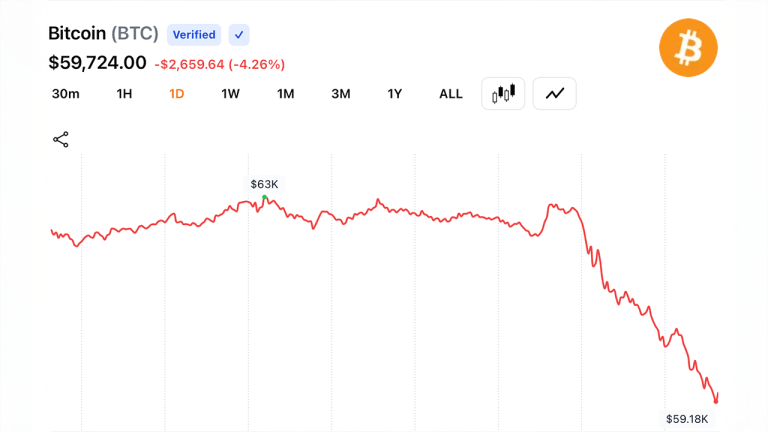
Bitcoin Hits $59,018 After a 5% Drop, Forcing $237M in Long Liquidations
On June 24, bitcoin fell 5% in 24 hours to a new year-to-date low of $59,018. This marks a nearly 10% drop over the week and a 30%+ decline since the start of the year. Bitcoin Hits New YTD Low Below $60K Bitcoin dipped below $60,000 on June 24 amid a marketwide sell-off that saw