This autism-specific school is growing as parents demand options outside the mainstream
Niddrie Autistic School will soon expand beyond year 3 for the growing cohort of families who believe traditional schooling doesn’t suit.
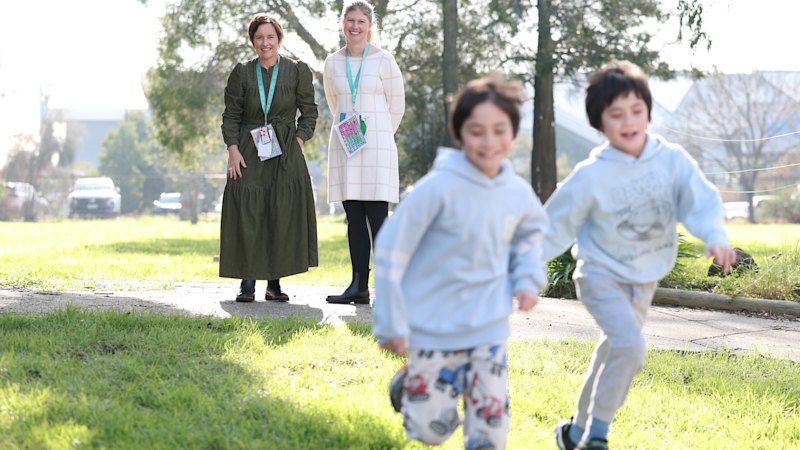
Families of children with autism will be afforded more choice for educating their kids, after winning a years-long battle to grow an autism-specific school in Melbourne’s north-west. Niddrie Autistic School has acquired an additional campus in Keilor East, offering families the chance to continue educating children beyond year 3 outside mainstream settings. Victoria’s education minister said the autism-specific curriculum was a look into the future for this growing cohort of students.
However, it also feeds into an ongoing debate between experts about balancing support and choice for autistic children while not segregating them from mainstream schools. Principal Lauren Topp said students had traditionally transitioned to specialist schools or the mainstream system by year 4, but that wasn’t the best fit for all families. “We try to support families to find the setting that best meets their child’s needs,” Topp said.
Niddrie will take over the former Essendon Keilor College campus, which was shut down in 2025. Year 4 students will be enrolled at the autism-specific public school for the first time next year, with plans to accept year 5 students from 2028. The state government is considering further expansion of Niddrie to senior primary and secondary years, in response to growing demand and a push from the school community.
A P-12 autism-specific school would ease pressure on nearby specialist schools that are reaching enrolment capacity. Topp said enrolment at Niddrie was restricted to students with a formal autism diagnosis and a language score below 70, which typically indicated significant communication challenges. “Our families are often very keen to stay with us as they feel like we really understand their children and understand their needs, and we can provide that intensive support,” she said.
Student-to-teacher ratios at Niddrie allow for two teachers and one education support staff member for every eight students. The state and federal governments provided almost $74,000 per Niddrie student in 2024, according to the most recent publicly available data, to address their complex needs. Education Minister Ben Carroll said there was a shortfall of secondary specialist schools in Melbourne and right around Australia.
“For over a decade, parents have been talking to me about expanding the Niddrie Autistic School, so this is certainly a giant first step,” he said. The deputy premier said more choice for families and more purpose-built schools with an autism-specific curriculum were the future for this cohort, and he would always support integration with mainstream schools. “We want every one of these students to know that they are gifted, that they have strengths, and they have just as much potential as anyone else,” Carroll said.
A royal commission into whether to separate students with a disability from mainstream schools split commissioners when the report was handed down in 2023. The outcome of the divided recommendations was the continuation of segregated education, despite the only two commissioners with a disability recommending a phase-out of standalone facilities by 2051. Victoria will open a standalone specialist school in Officer in 2027.
A mainstream secondary school will open in Wyndham Vale and a mainstream primary school will open in Clyde North in 2028, both with co-located specialist campuses. Catherine Smith, from the University of Melbourne’s education faculty, said Thriving Kids, the federal government’s policy for supporting children aged eight and under with autism or developmental delay, recommended supporting young people where they “live, learn and play”. “Creating more segregated locations for education seems counterintuitive to what we’ve agreed is the best way forward, and what we’ve committed to in terms of international conventions and rights,” she said.
“Certainly, there are plenty of advocacy organisations that would say that opening more schools is the wrong way to go.” Smith said it was understandable that some families advocated for separation from the mainstream system, particularly given that students who were neurodiverse or had a disability experienced a higher risk of bullying. “Something that we have to consider in terms of the voices of the people involved here is that many of the schools where kids currently attend just don’t have the resources to meet the needs of some students,” she said.
Autism is rising in Australia, with 4.3 per cent of children aged between five and 14 years old in 2022, up from 3.2 per cent in 2018.
Smith said autism was likely more prevalent due to increased awareness and the development of discourse around neurodivergence, which meant people felt more comfortable seeking a diagnosis. She said demand for specialist schools was likely to increase as NDIS support became more difficult for children aged under eight to access. The decline in wraparound support could see those families opt for specialist schools, Smith said.
“We are already se
Đọc thêm từ Thế giới

Lindsey Graham likely died from aortic rupture, medical examiner says
US Senator Lindsey Graham, a close ally of President Donald Trump and a leading Republican voice on foreign policy, died on Saturday after a brief illness, his office said. He was 71. The District of Columbia medical examiner said the preliminary cause of death was an aortic diss

미군 "이란에 추가공습 개시…호르무즈 상선 공격역량 약화"
(워싱턴=연합뉴스) 백나리 특파원 = 미군 중부사령부는 12일(현지시간) 호르무즈 해협에서 상선을 위협하는 이란을 상대로 추가 공습을 개시했다고...
Australia news live: auction clearances nudge up after weeks under 50%; state farewell for Richard Scolyer
Almost 55% of homes at auction were sold, weekend figures show. Follow today’s news liveGet our breaking news email, free app or daily news podcastRichard Scolyer to have state memorial service at Sydney Opera HouseRichard Scolyer, the 2024 Australian of the Year, will be honoure
![[유형재의 새록새록] 숲속 육아 전쟁, 어미 꾀꼬리의 세상 가장 고운 노래](https://img.yna.co.kr/etc/inner/KR/2026/07/09/AKR20260709160500062_01_i_P2.jpg)
[유형재의 새록새록] 숲속 육아 전쟁, 어미 꾀꼬리의 세상 가장 고운 노래
(강릉=연합뉴스) 유형재 기자 = 어미 꾀꼬리가 갓 태어난 새끼가 있는 둥지로 돌아가기 직전 세상 가장 아름답고 부드러운 소리를 내며 작은 숲을...