The scam that doesn’t rug: How $VLAD farms its victims
Hackers used Tenev's account to launch a token that cannot rug and pays them fees forever. The rug pull just became a yield product.
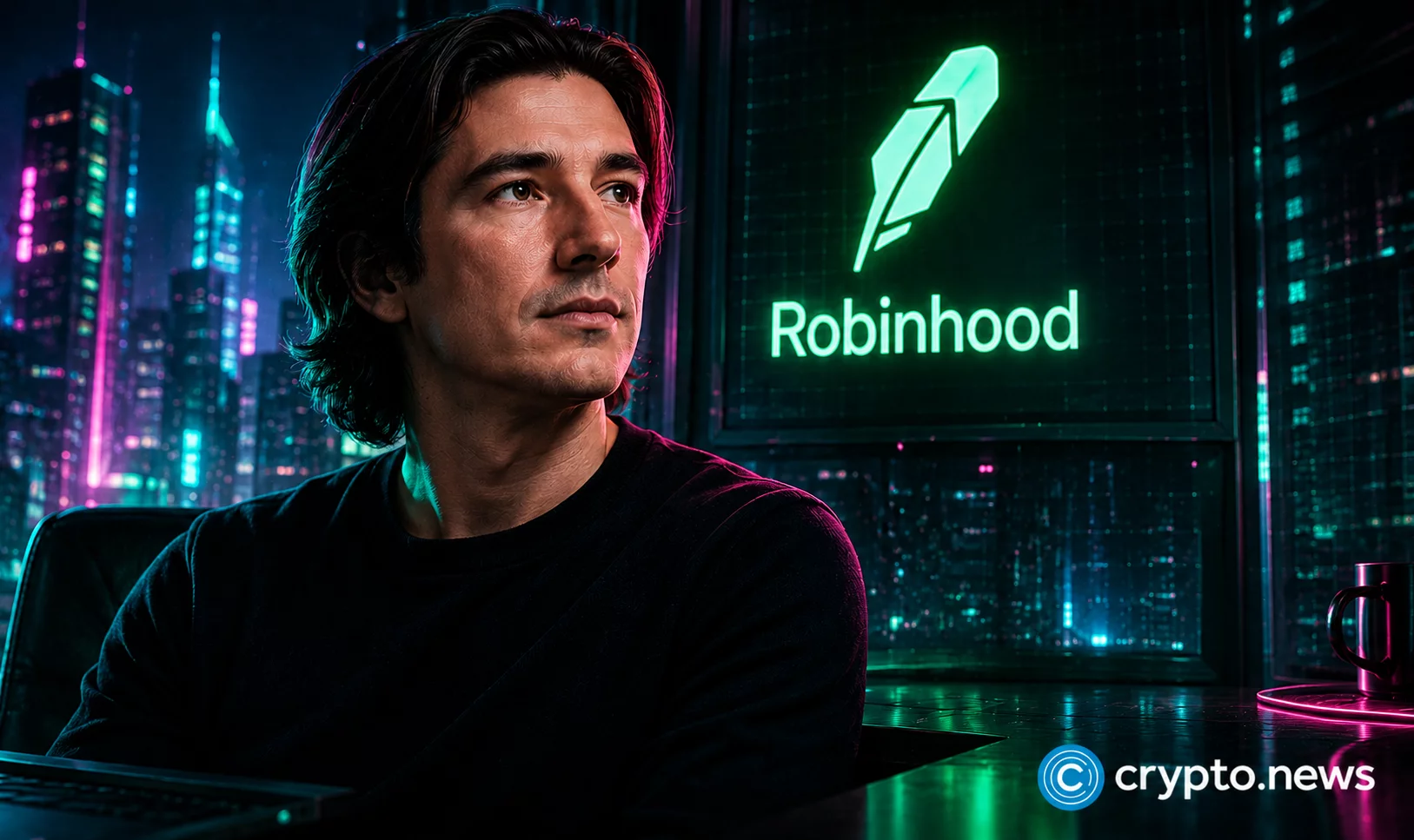
Share Link copied When hackers hijacked Robinhood’s CEO’s X account, they did not run the usual smash-and-grab. They launched a token whose liquidity is locked forever, un-ruggable by design, and are collecting trading fees from it in perpetuity. The rug pull just evolved into a yield product, and the anti-scam infrastructure built the machine.
Summary Hackers compromised Robinhood CEO Vlad Tenev’s X account on Thursday and promoted Vladhood ($VLAD) as the “official mascot” of Robinhood Chain, drawing 175,000 views in under 20 minutes and $22 million in trading volume. The operation was premeditated, not opportunistic: the token contract deployed 46 minutes before the hacked post, through the Pons launchpad, with Tenev’s own X profile listed as the token’s official website. The mechanism is the story: Pons locks a token’s liquidity permanently, making rug pulls impossible, but lets creators claim trading fees, so the attacker farms income from every trade, roughly $59,000 claimed in the first hours and still accruing, atop total proceeds estimated at $1.
2-1.3 million. The design inverts a decade of scam economics: instead of one exit event, the scammer holds a perpetual annuity on victim activity, and the anti-rug protection that legitimizes the launchpad is precisely what guarantees the income.
It is the second executive-account token scam on Robinhood Chain in eleven days, six days before the company’s earnings call, and it poses a question the industry has not answered: who is liable when scam-proofing infrastructure becomes the scam’s business model. Crypto crime has a classical form, refined over a decade: create a token, manufacture credibility, collect the victims’ money, and vanish, the rug pull, a crime with a beginning, a middle, and above all an end. What happened on Thursday, when hackers seized the X account of Robinhood’s chief executive and pointed 15 million followers at a memecoin called Vladhood, had the beginning and the middle and then, deliberately, no end.
The attackers launched $VLAD through a launchpad whose signature safety feature locks a token’s liquidity forever, which means the token cannot be rugged, which means, and here is the inversion worth an entire article, the scam never has to stop. The locked pool collects trading fees on every swap, the launchpad pays those fees to the token’s creator, and the creator is the hacker, who called the fee-collection function six times in the first two hours and has no reason ever to stop calling it. The rug pull was a robbery.
This is a toll booth, built on stolen credibility, operated in public, generating income for its architect with every trade, protected by the exact mechanism the industry built to protect traders. The Defiant’s on-chain forensics documented the machine within hours; what the machine means, for scam economics, for the launchpads, and for the brokerage whose chain now hosts its second executive-impersonation token in eleven days, is the subject here. LATEST: Robinhood CEO Vlad Tenev X account hacked to promote fake memecoinHackers pushed a purported official $VLAD token as the Robinhood Chain mascot before the account was secured pic.
twitter.com/kuMduz7Vbv— crypto.news (@cryptodotnews) July 24, 2026 The operation, reconstructed The timeline, assembled from on-chain records and the forensic work of The Defiant and Onchain Lens, settles the fact that reframes everything else: this was a single coordinated operation, planned around the account takeover, not a scammer riding a lucky hack.
At 12:38 pm ET on Thursday, a wallet with no prior history launched Vladhood through Pons, the busiest of the Pump.fun-style launchpads that colonized Robinhood Chain in its first month. The launch parameters included a detail that functions as a confession of premeditation: the token’s official website field listed Tenev’s X profile URL, meaning the creators configured the token around an account they did not yet publicly control.
Forty-six minutes later, the post appeared on that account: Does Robinhood love memes? The answer is yes, introducing $VLAD as the official mascot of Robinhood Chain, falsely promising a Robinhood app listing, signed off, Welcome to the Hood, with the contract address attached. The credibility stack was complete: a verified account, a CEO’s voice, a chain the CEO actually launched three weeks earlier, and a claim, app listing, that sat exactly on the boundary of plausible.
The market did what engineered credibility makes it do. The post drew more than 175,000 views in under 20 minutes; the token ran up more than 90,000% from launch; volume reached $22 million across roughly 85,000 swaps in the main pool; the market cap touched somewhere between $4 million and $10 million depending on the snapshot; 5,266 holders and 137,000 transfers accumulated on a contract deployed that afternoon. Robinhood’s communications team confirmed the compromise roughly 41 minutes after the post and worked with X to delete it; the ch
Đọc thêm từ Tiền số / Crypto

Why Google Stock Crashed 7% Despite Big Revenues in Earnings Call
Alphabet published robust revenues in its recent Q2 earnings call and beat all market expectations. Despite the strong…

DHS diverts anti-China funds to FIFA World Cup security, reshuffling federal cybersecurity priorities
DHS redirected anti-China funds to FIFA World Cup 2026 security, reshuffling over $1B in federal spending with implications for cybersecurity and The post DHS diverts anti-China funds to FIFA World Cup security, reshuffling federal cybersecurity priorities appeared first on Crypt

Balance Stablecoin Collapse: How an Oracle Exploit Broke the Peg
Balance Coin's 99% crash on July 22, 2026 followed an oracle exploit draining BTC vaults; attacker netted about $912k. What broke, who lost, and how to vet stablecoins.
Bitfinex completes El Salvador licence set across three markets
Bitfinex completes El Salvador licensing across spot, derivatives and tokenized securities, extending its regulated Latin American footprint