The right to walk: After Supreme Court judgement, who will reclaim our footpaths?
EditionININUSGCCEnglishEnglishहिन्दीमराठीಕನ್ನಡதமிழ்বাংলাമലയാളംతెలుగుગુજરાતીWeatherSign InTOIToday's ePaperLive EditionININUSGCCEnglishEnglishहिन्दीमराठीಕನ್ನಡதமிழ்বাংলাമലയാളംతెలుగుગુજરાતીWeatherSign In TOIToday's ePaperLive NewsIndia NewsThe right to walk: After Supreme Court judg
EditionININUSGCCEnglishEnglishहिन्दीमराठीಕನ್ನಡதமிழ்বাংলাമലയാളംతెలుగుગુજરાતીWeatherSign InTOIToday's ePaperLive EditionININUSGCCEnglishEnglishहिन्दीमराठीಕನ್ನಡதமிழ்বাংলাമലയാളംతెలుగుગુજરાતીWeatherSign In TOIToday's ePaperLive NewsIndia NewsThe right to walk: After Supreme Court judgement, who will reclaim our footpaths?TrendingMumbai rainBy-election dateVaibhav sooryavanshiE20 Petrol MileageSiya GoyalITR FilingWeather tomorrowIndias passport RankingMumbai rainBy-election dateVaibhav sooryavanshiE20 Petrol MileageSiya GoyalITR FilingWeather tomorrowIndias passport RankingMumbai rainBy-election dateVaibhav sooryavanshiE20 Petrol MileageSiya GoyalITR FilingWeather tomorrowIndias passport RankingThe right to walk: After Supreme Court judgement, who will reclaim our footpaths?Ananya Podder / TIMESOFINDIA.
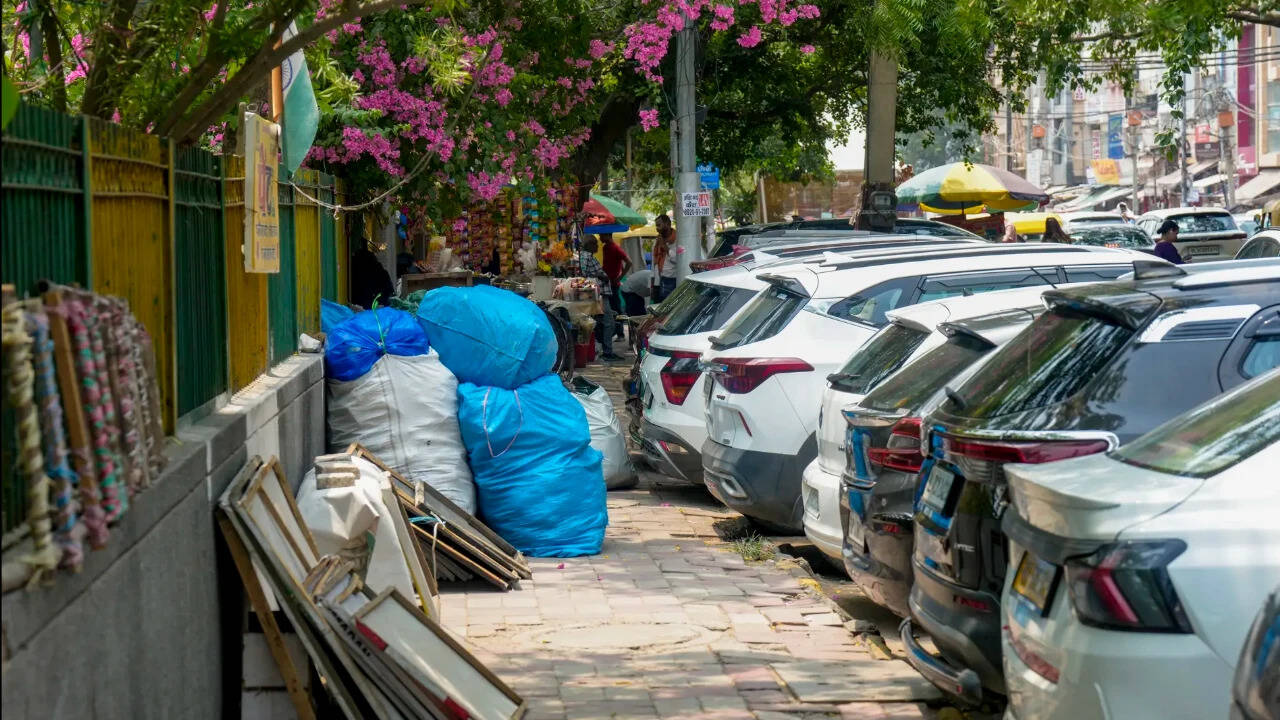
COM / Updated: Jul 05, 2026, 16:45 ISTCommentsShareAA+Text SizeSmallMediumLarge Parked vehicles and stored goods occupy a footpath, obstructing pedestrian movement, at Lajpat Nagar, in New Delhi. (PTI Photo) A five-year-old child was killed by a tanker on his way to school with his father. At the site of the tragedy, there was no footpath or a proper pedestrian crossing.
On June 19, in a compensation case (Maniyar Iliyaz @ Shaik Riyaz v. P. Ayyappan) delivered by a bench of Justices P S Narasimha and A S Chandurkar, Supreme Court declared the right to walk on safe, demarcated footpaths as a fundamental right under the right to free movement under Article 19(1)(d) and the right to life under Article 21.
Watch Supreme Court, Broken Pavements and Delhi's Pedestrians: Ground ReportThe bench said that accidents like this continue and perhaps they are inevitable until our rights regime is restructured regarding access to roads.It further stated that the Motor Vehicles Act of 1988 neither recognises nor has ever recognised a fundamental right to walk and in fact, the law has actually hindered this right, weakening pedestrians' rights in many respects.“The irony all along has been that we have often celebrated flyovers, expressways and large road projects, but have ignored the most basic unit of movement i.
e. the pedestrian. The judgment should change how footpaths are imagined.
They must be continuous, walkable, safe, accessible and free from obstruction,” said advocate Mayank Arora with The Chambers of Bharat Chugh.Data shows that from January to March this year, Delhi traffic police handed out 4,30,202 on-the-spot fines for improper or obstructive parking, making it the city’s most frequently committed traffic offence.Crisis of pedestrian fatalityA simple stroll around Delhi reveals how non-functional most of its footpaths are.
Broken slabs, potholes and garbage strewn everywhere are a common sight. They are dug up or interrupted abruptly. This forces dwellers onto the main road, where they face the threat of collision with vehicles.
India Status Report on Road Safety, compiled by the Transportation Research and Injury Prevention Centre (TRIPC) at IIT Delhi, indicates that footpath availability ranges from as low as 3% in Jammu and Kashmir to about 73% in Maharashtra. In states like Bihar, Haryana and Puducherry, usable pavements remain scarce.Recent data released by road transport ministry for 2024 revealed that more than 1.
8 lakh pedestrians were killed in road crashes across India between 2019 and 2024. It averages to an annual of 30,500 pedestrian fatalities. National Highway (NH) network accounted for nearly 31% of these deaths.
Around 54% of pedestrian deaths involved collisions with two-wheelers and cars, claiming 19,680 lives. The absence of safe footpaths and pedestrian crossing infrastructure is behind the country’s pedestrian fatality toll, which is among the highest globally.Right reserved for the privilegedThe bench called it strange that it escaped them to focus on recognizing and securing this right to walk.
“It may be because wheels eclipsed our imagination, and our municipal administration was busy creating roads suitable for motorized vehicles,” said the court.“It could also be elitism to start with, for machines with wheels were only for the rich, but as economies progressed and cheaper motor vehicles were introduced, the entire spectrum of motorized transportation dominated the roads, pushing aside the walkers to the extent that they are treated as a nuisance for the drivers who routinely run over the walkers and their footpaths.”Shweta Raj, who comes from Bihar’s Samastipur, says the concept of footpaths ends once you leave Patna.
“As soon as you deviate from the capital, you will see the footpaths disappearing,” she said. “In the rural areas, even the main roads aren’t properly built. Functional footpaths are out of the question.”
In her own city, footpaths only exist on bridges. Even then, they are blocked by vegetable stalls or parked motorcycles.Question of hawkers and homeless peopleThe question of hawkers, encroached spaces and the right to earn a livelihood has dominated the contemporary Indian d
Đọc thêm từ Thế giới
예멘 홍해 지나던 화물선…정체불명 무장 괴한에 피격
본문국제중동·아프리카예멘 홍해 지나던 화물선…정체불명 무장 괴한에 피격김지은기자수정 2026-07-05 22:49펼침0:00Your browser does not support theaudio element.구글 선호 매체 등록1일(현지시각) 오만 무산담에서 바라본 호르무즈해협에 선박들이 떠 있다.
England v Australia: Women’s T20 Cricket World Cup final – live
All the latest news from Sunday’s final at Lord’sEngland book final date with Australia | Mail James“C’mon ICC!” Ora shouts from the stage. That is quite funny. In February 2023, after Australia won their fourth consecutive world title, at Newlands, Beth Mooney was asked what adv

Couple ‘dined on Dover sole and calamari’ before leaving restaurant ‘without paying’
It is alleged that the couple walked out on a £115 bill at the upmarket seafood restaurant

Upper Bhadra Project will be completed by 2028: Karnataka Water Resources Minister Ramalinga Reddy
Minister for Water Resources Ramalinga Reddy, who reviewed the progress of the Upper Bhadra project at Lakkavalli, near Chikkamagaluru, on Sunday (July 5), said the government was hopeful of completing the project by 2028, before the completion of the Congress party’s term.Speaki