Space Solar Power Station Written into China's 15th Five-Year Plan, Three Technical Paths Mapped Out
China's space solar power station initiative enters national planning for the first time, with three technology roadmaps converging around energy materials, wireless transmission, and orbital infrastructure.
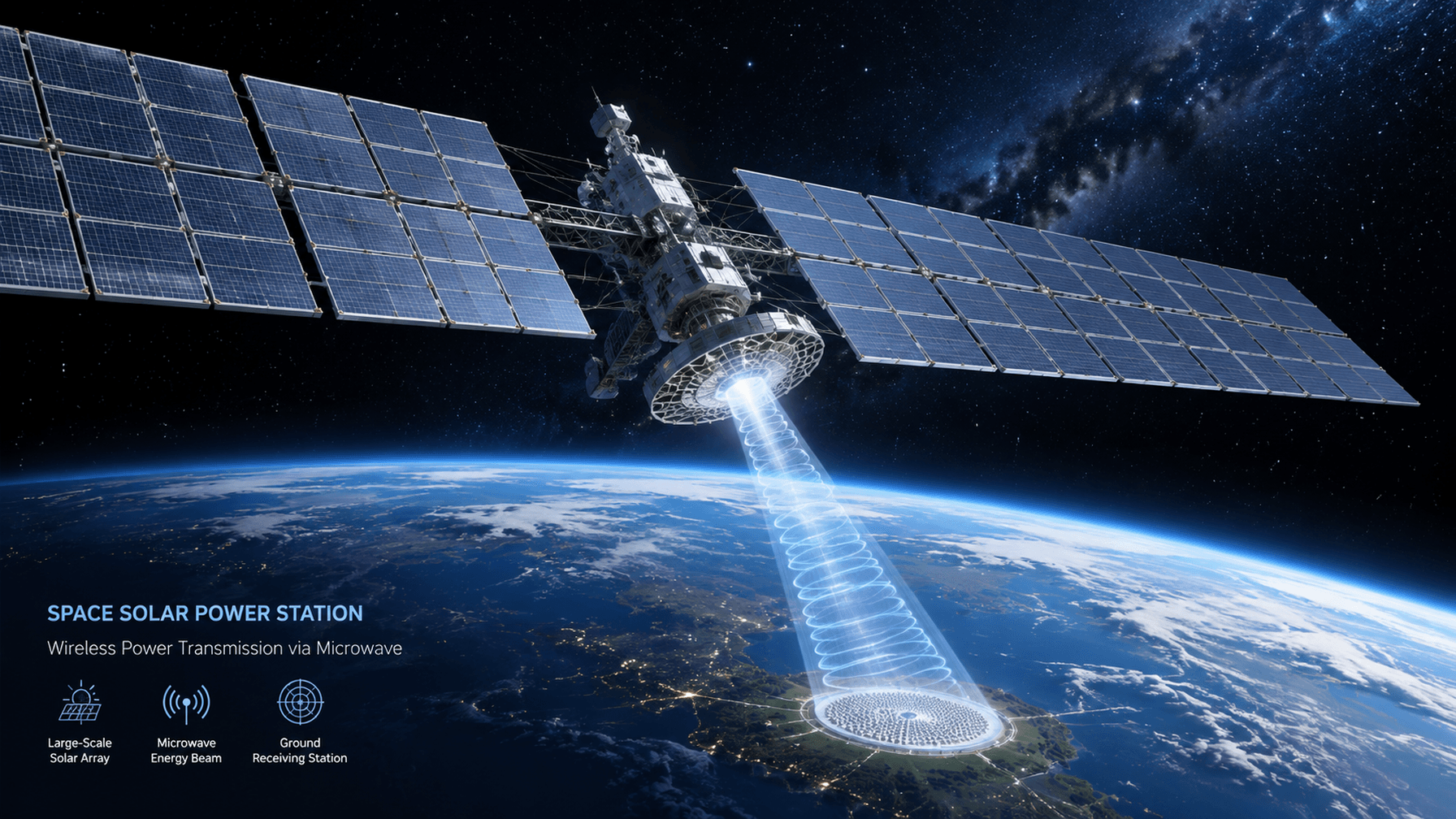
China's space solar power station initiative has been formally included in the nation's 15th Five-Year Plan for the first time, signaling a strategic shift from conceptual research toward engineering pre-development of space-based energy infrastructure, according to the newly released New Energy System Construction plan jointly published by the National Development and Reform Commission and the National Energy Administration. While the plan's reference to space solar power is brief, its inclusion carries significant weight. It represents a directional advance deployment — exploring long-term energy solutions beyond 2050 at the national planning level.
The space solar power station concept involves collecting solar energy in geostationary orbit where sunlight is available 24/7 at roughly 10 times terrestrial intensity, then transmitting it to Earth via microwave or laser beams. Three technology pathways are converging toward engineering validation. The first is energy materials: ultra-high-efficiency solar cells capable of withstanding the space radiation environment.
Gallium arsenide cells remain the mainstream solution with over 30% conversion efficiency, while crystalline silicon and emerging perovskite thin-film technologies offer promising cost-reduction paths. China's dominance in global silicon photovoltaic manufacturing — over 90% of global capacity — provides a unique industrial foundation. The second pathway is wireless power transmission.
Professor Duan Baoyan's "Zhuri Project" has constructed the world's first full-chain ground verification system for space solar power stations, achieving kilowatt-level power output over hundred-meter distances with dynamic target microwave transmission. Meanwhile, Professor Yang Shizhong's team has pursued stratospheric power generation and both microwave and laser wireless transmission paths. Additional teams at the China Academy of Space Technology, Institute of Electrical Engineering at CAS, Beijing Institute of Techn
Đọc thêm từ Công nghệ

3 méthodes simples pour dupliquer l'écran de votre smartphone Android sur la TV du salon
Votre smartphone Android est un formidable outil pour capter les diffusions officielles en haute définition. Mais hors de question de s'abîmer les yeux sur un petit écran de 6 pouces ! Voici les trois méthodes les plus efficaces et fiables pour dupliquer l'écran de votre smartpho
Prime Day is over, but these 5 deals are still live (and you don't want to miss them)
Amazon Prime Day is over, but some of my favorite offers are still available, including deals on the Ninja Slushi, Garmin Fenix 8 Pro, Walmart Plus, and more.

Shanghai-based Momenta, whose driver-assist tech is used by Toyota, Mercedes, and Audi in China, files for an IPO in Hong Kong, seeking to raise up to $751.1M (Reuters)
Reuters: Shanghai-based Momenta, whose driver-assist tech is used by Toyota, Mercedes, and Audi in China, files for an IPO in Hong Kong, seeking to raise up to $751.1M — Chinese self-driving technology firm Momenta Global launched its Hong Kong initial public offering on Monday …

Funded: I keep a notebook by my bed with one question about SEA climate
I keep a small notebook by my bed. Not for ideas. Just things I don’t want to forget. Last week I wrote: “What does this place look like in 2040?” Not for a deck. Not for a client. I don’t have kids. The usual anchors people use to think about the future, school fees, inheritance