South China Sea joint statement rejects China’s maritime claims
The joint statement may de-escalate regional tensions, potentially reducing the risk of military conflict and altering geopolitical dynamics. The post South China Sea joint statement rejects China’s maritime claims appeared first on Crypto Briefing.
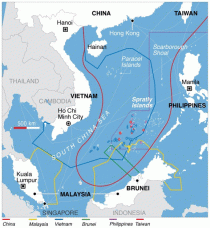
https://www.aph.gov.
au/About_Parliament/Parliamentary_departments/Parliamentary_Library/Research/Chronologies/2021-22/SouthChinaSeaChronology South China Sea joint statement rejects China’s maritime claims China x philippines military clash before 2027 Share Add us on Google by Estefano Gomez Jul. 12, 2026 A joint statement on the South China Sea issued by several countries has declared China’s maritime claims as having no legal basis. This development comes amid ongoing territorial disputes involving China and other countries in the region, including the Philippines, Vietnam, Malaysia, Brunei, and Indonesia.
The assertion aligns with a 2016 ruling by an international tribunal that unanimously rejected China’s claims outlined by the “Nine-Dashed Line.” The situation has heightened tensions, particularly between China and the Philippines, raising concerns over potential military conflict. Market pricing suggests that the joint statement could reduce the likelihood of clashes by undermining China’s claims.
Advertisement Key Takeaways The joint statement appears to align with the 2016 tribunal ruling, rejecting China’s maritime claims in the South China Sea. Pricing in related markets suggests decreased likelihood of a military clash between China and the Philippines following the statement. Observers note the statement may serve to de-escalate tensions in the region, consistent with a reduction in conflict scenarios.
What to Watch Stakeholders will closely monitor China’s response to the joint statement and any subsequent diplomatic actions by the involved nations. Developments such as a new hotline agreement or a pullback of Chinese vessels from disputed areas could further reduce conflict probabilities. However, increased military activities or renewed confrontations at key locations like the Second Thomas Shoal may shift market perceptions back towards a higher risk of clashes.
Get live prediction-market analysis, powered by Vera. Sign up for Vera. Disclosure: This article was edited by Estefano Gomez.
For more information on how we create and review content, see our Editorial Policy. MACRO South China Sea joint statement rejects China’s maritime claims China x philippines military clash before 2027 by Estefano Gomez Jul. 12, 2026 Share Add us on Google https://www.
aph.gov.au/About_Parliament/Parliamentary_departments/Parliamentary_Library/Research/Chronologies/2021-22/SouthChinaSeaChronology A joint statement on the South China Sea issued by several countries has declared China’s maritime claims as having no legal basis.
This development comes amid ongoing territorial disputes involving China and other countries in the region, including the Philippines, Vietnam, Malaysia, Brunei, and Indonesia. The assertion aligns with a 2016 ruling by an international tribunal that unanimously rejected China’s claims outlined by the “Nine-Dashed Line.” The situation has heightened tensions, particularly between China and the Philippines, raising concerns over potential military conflict.
Market pricing suggests that the joint statement could reduce the likelihood of clashes by undermining China’s claims. Advertisement Key Takeaways The joint statement appears to align with the 2016 tribunal ruling, rejecting China’s maritime claims in the South China Sea. Pricing in related markets suggests decreased likelihood of a military clash between China and the Philippines following the statement.
Observers note the statement may serve to de-escalate tensions in the region, consistent with a reduction in conflict scenarios. What to Watch Stakeholders will closely monitor China’s response to the joint statement and any subsequent diplomatic actions by the involved nations. Developments such as a new hotline agreement or a pullback of Chinese vessels from disputed areas could further reduce conflict probabilities.
However, increased military activities or renewed confrontations at key locations like the Second Thomas Shoal may shift market perceptions back towards a higher risk of clashes. Get live prediction-market analysis, powered by Vera. Sign up for Vera.
Disclosure: This article was edited by Estefano Gomez. For more information on how we create and review content, see our Editorial Policy.
Đọc thêm từ Tiền số / Crypto

Nvidia investors need to pay attention on July 16
Nvidia's strategic engagement in China amid export restrictions highlights the growing importance of sovereign AI and decentralized computing. The post Nvidia investors need to pay attention on July 16 appeared first on Crypto Briefing.

Russian strike near Sumy coffee shop causes panic, civilian flight
The escalation in Sumy underscores the persistent threat to Ukrainian defenses and highlights the stalled diplomatic efforts amid ongoing conflict. The post Russian strike near Sumy coffee shop causes panic, civilian flight appeared first on Crypto Briefing.

US government moves to restrict Chinese open-weight AI models after repeated distillation warnings
US restrictions on Chinese AI models may inadvertently boost decentralized AI and crypto markets, challenging regulatory control efforts. The post US government moves to restrict Chinese open-weight AI models after repeated distillation warnings appeared first on Crypto Briefing.

Senegal fires head coach Pape Thiaw after World Cup exit, exposing a football federation in crisis
Senegal's coaching change highlights deeper systemic issues within its football federation, risking future competitiveness and financial stability. The post Senegal fires head coach Pape Thiaw after World Cup exit, exposing a football federation in crisis appeared first on Crypto