Slug sleuths on the trail of gorging gastropods
How predicting slugs' behaviour is helping farmers and their crops.
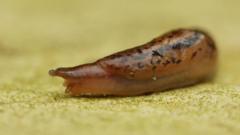
Image source, Chris Ison / PAImage caption, More than 100 farms have contributed data to help find a way to map out slugsByCharlie StubbsWest MidlandsPublished7 minutes agoArable farmers may soon be able to stop slugs eating their crops thanks to research by a Shropshire-based university and the work of "slug sleuth" farmers.Data collected by 28 "slug sleuths" has helped researchers from Harper Adams University find environmentally friendly slug control methods in the form of "prediction maps".It is part of a three-year, £2.
6 million research programme that was funded by the Department for Environment, Food and Rural Affairs (Defra).Researchers hope the maps could lead to "more precise control of slugs in arable fields" and reduce using pesticides.The model is one of the many projects done by the "Strategies Leading to Improved Management and Enhanced Resilience to Slugs" (SLIMERS).
Professor Keith Walters from the university said the research suggested where slugs were more likely to show up, in particular how slug clusters re-established themselves after soil was waterlogged. "We have now confirmed that patches reform temporarily in places we wouldn't expect in normal conditions and then quickly return to their predicted areas once more typical soil conditions return," Walters added."Despite low slug numbers over the testing period we have sufficient data to prove that the model works, and perhaps most importantly, that farmers are happy to use it and it fits in with modern commercial equipment."
Image source, Harper Adams UniversityImage caption, Data has been collected by 28 "slug sleuth" farmersMore than 100 farms have been involved in the scheme, including Bedfordshire-based wheat farmer Charles Paynter.He said the work would help him better predict how slugs may strike. "This means we will be able to use more targeted treatments which has the potential to be less damaging to biodiversity," Paynter added."
My threshold for taking control measures is higher now because I have been able to prove to myself that I can evaluate the risks from slug activity with greater accuracy."Get in touchTell us which stories we should cover in ShropshireContact formContact formFollow BBC Shropshire on BBC Sounds, Facebook, external, X, external and Instagram, external. Related topicsEnvironmentConservationSlugsRelated storiesHungry slugs returning after dry weather to munch on strawberriesPublished3 JuneTears and celebrations as river 'wiggle' restoredPublished5 days ago 7 minutes ago Get in touchTell us which stories we should cover in ShropshireContact formContact form Hungry slugs returning after dry weather to munch on strawberriesPublished3 June 3 June Tears and celebrations as river 'wiggle' restoredPublished5 days ago 5 days ago
Đọc thêm từ Khoa học
AI just supercharged the race to find room temperature superconductors
Scientists have combined machine learning with quantum physics to discover two new superconductors and create a much faster way to search for many more. The technique could bring researchers significantly closer to the long-sought goal of a room-temperature superconductor.
Japan's 1st pig kidney transplant trial eyed as early as 2028
A Japanese startup said Monday it will conduct clinical trials of pig kidney transplants to humans at two hospitals as early as 2028, which if successful would likely make them the first of their kind in the country.
CA9 as a therapeutic marker for hepatocellular carcinoma
A research group including Doctoral Student Yu Sato and Professor Takahiro Kodama of the Graduate School of Medicine at the University of Osaka, has clarified that the pre-treatment blood CA9 concentration serves as a biomarker to predict the therapeutic efficacy of atezolizumab/
Kanazawa University and Kyoto University visualize how cyclic molecules assembled on a substrate capture guest molecules
A joint research group including Professor Hitoshi Asakawa of the Faculty of Chemistry, Institute of Science and Engineering and Professor Mikihiro Shibata of the Nano Life Science Institute at Kanazawa University and Professor Tomoki Ogoshi of the Graduate School of Engineering