Show HN: Claude-thermos – keeps your Claude session warm for you
Article URL: https://github.com/izeigerman/claude-thermos Comments URL: https://news.ycombinator.com/item?id=49024882 Points: 6 # Comments: 2
mainBranchesTagsGo to fileCodeOpen more actions menuFolders and filesNameNameLast commit messageLast commit dateLatest commit History40 Commits40 Commits.github/workflows.github/workflows src/claude_thermossrc/claude_thermos teststests .
gitignore.gitignore LICENSELICENSE MakefileMakefile README.mdREADME.
md pyproject.tomlpyproject.toml uv.
lockuv.lock View all filesRepository files navigationclaude-thermos Stop paying to rebuild your Claude Code cache. When your main agent waits on a subagent for more than 5 minutes, its prompt cache silently expires, and the next turn re-encodes your entire conversation at the write rate instead of reading it back cheap.
On long sessions with many subagents that's roughly 20% of your bill. claude-thermos keeps the cache warm so you never pay that tax. Use Run Claude Code exactly as you normally would, but through claude-thermos with uvx: uvx claude-thermos # instead of: claude uvx claude-thermos -p "fix the bug" # any claude args pass straight through Requires Python 3.
11+ and the claude CLI on your PATH. That's it. Warming runs automatically in the background.
To disable it for a run without changing the command, set CLAUDE_WARMER_DISABLE=1. Tuning (all optional): Flag Default Meaning --idle 270 Seconds the main agent must be idle before warming kicks in --interval 270 Seconds between warming cycles --max-cycles 4 Max warms per idle episode (auto for unlimited) --subagent-window 540 Seconds a subagent counts as "still active" Why your cache keeps expiring Claude Code's prompt cache uses a 5-minute TTL. Every turn, your whole conversation history is served from cache at 0.
1x the input price instead of being re-sent at full price, as long as the cache stays alive. The cache expires if more than 5 minutes pass between requests on the same prefix. The dominant trigger for that gap is not you thinking.
It's the main agent blocked on a subagent that runs longer than 5 minutes. A subagent has a different system prompt and tool set, so its requests have a different cache prefix and never refresh the main agent's. While the subagent works, the main agent's cached history ages untouched; past 5 minutes it's gone.
When the subagent returns, the main agent resumes with a byte-identical, append-only history, and finds its cache missing, forcing a full re-encode at the 1.25x write rate. By then the history is large, so the re-encode is expensive: individual collapses re-write 200K to 500K tokens.
Measured across roughly 185 local sessions, these rebuilds accounted for about 22% of the total bill, money spent re-encoding content that was already cached moments earlier. How it works claude-thermos launches Claude Code behind a small local reverse proxy (it points ANTHROPIC_BASE_URL at a loopback port; all traffic still goes to the real Anthropic API). Observe.
The proxy watches /v1/messages traffic and groups it into sessions and lineages, a lineage being one cache prefix, keyed by model + tool set + system text. The first tool-bearing lineage is the main agent; the rest are subagents. Detect the danger window.
When the main lineage goes idle and a subagent is actively running, the main prefix is at risk of expiring. Warm. On an interval under the 5-minute TTL, it replays the main agent's last real request as a warm request: identical cacheable prefix, but max_tokens: 1 and no streaming.
The single token is thrown away; the point is the prefill, which reads and refreshes the full cached prefix. Warm requests go directly to the API, never through the proxy, so they can't disturb real traffic. Result.
When the subagent finishes, the main agent's cache is still warm. It pays a cheap read instead of a full rewrite. Each warm costs a cache read (0.
1x); each rewrite it prevents would have cost a write (1.25x) on a much larger prefix, so the trade is heavily in your favor. Event logs & savings Every session writes to: ~/.
claude-thermos/logs/<session_id>/ ├── events.jsonl # append-only structured event stream └── summary.json # rollup totals, written when the session ends events.
jsonl records each request/response's token usage plus every warming decision (warm_fired, warm_result, cap_reached, resume_detected, and so on). summary.json is the rollup you'll usually read: Field Meaning warms_fired Warm requests sent cache_read_total Tokens read back by those warms episodes Idle-with-subagent episodes that ended in a successful resume (a rewrite actually avoided) rewrite_avoided_tokens Tokens that would have been re-written, summed across episodes warm_cost What warming cost you: 0.
1 × cache_read_total rewrite_avoided_cost What it saved: 1.25 × rewrite_avoided_tokens net_savings rewrite_avoided_cost − warm_cost All three cost figures are in base-input-token units (token counts already weighted by their cache multiplier). To turn net_savings into dollars, multiply it by your model's price per input token: dollars saved ≈ net_savings × (input token price) For example, at an input price of $3 / 1M tokens
Đọc thêm từ Công nghệ
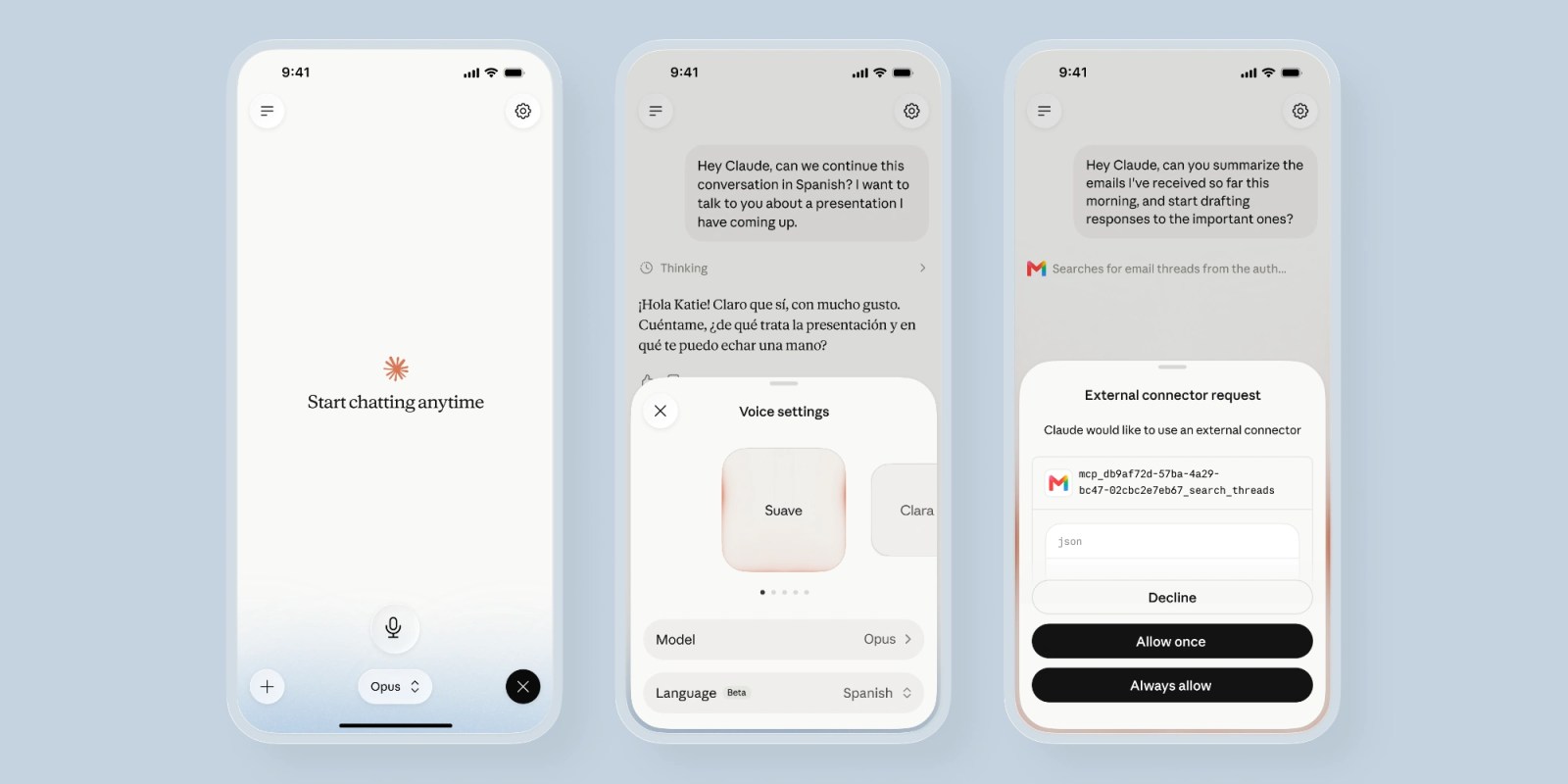
Anthropic upgrades Claude voice mode with more powerful models
Anthropic is bringing a long-overdue upgrade to voice mode in Claude today. The upgraded Claude voice mode has new capabilities and works with Opus and Sonnet models for the first time.

Foundation Future Industries, backed by Eric Trump, partners with AMD to develop autonomous humanoid robots using the AMD Ryzen AI Embedded X100 Series chips (Aishwarya Jain/Reuters)
Aishwarya Jain / Reuters: Foundation Future Industries, backed by Eric Trump, partners with AMD to develop autonomous humanoid robots using the AMD Ryzen AI Embedded X100 Series chips — Eric Trump-backed Foundation Future Industries said on Thursday it is partnering with AMD (AMD

AegisAI, which uses AI agents to detect AI-driven spear-phishing attacks, raised a $36M Series A led by Battery Ventures, bringing its total funding to $49M (Marina Temkin/TechCrunch)
Marina Temkin / TechCrunch: AegisAI, which uses AI agents to detect AI-driven spear-phishing attacks, raised a $36M Series A led by Battery Ventures, bringing its total funding to $49M — Hackers are increasingly using AI to launch attacks on a massive scale, with email emerging a
Anthropic updates Claude voice mode with more capable models
Claude's new voice model will let you reschedule your meeting or draft an email