Shopify’s head of engineering calls token leaderboards a mistake
Shopify's shift from volume to utility metrics highlights the need for outcome-focused AI adoption strategies to prevent resource misuse. The post Shopify’s head of engineering calls token leaderboards a mistake appeared first on Crypto Briefing.

Shopify’s head of engineering calls token leaderboards a mistake The company scrapped its internal AI usage rankings after realizing they incentivized waste, not value Share Add us on Google by Editorial Team Jun. 24, 2026 Shopify built a leaderboard to get employees excited about using AI. It worked a little too well.
Farhan Thawar, Shopify’s VP and Head of Engineering, has confirmed the company “killed” its original token leaderboard after discovering it created a perverse incentive: employees were burning through AI tokens to climb the rankings, not to actually accomplish anything useful. The phenomenon has a name now. It’s called “tokenmaxxing,” and it’s exactly what it sounds like, competitive overconsumption of AI resources for bragging rights.
The fix? Shopify replaced the leaderboard with a usage dashboard designed to measure utility rather than volume. The company also implemented spending alerts that trigger whenever a single user’s daily token spend exceeds $250.
Advertisement From vanity metrics to value metrics Shopify’s AI push began in 2025, around the same time CEO Tobi Lutke issued a memo establishing AI use as a baseline expectation across the company. The leaderboard was part of that cultural push, a way to normalize and encourage adoption. Shopify also built an internal LLM proxy for bulk token purchasing, centralizing how the company buys and distributes AI capacity.
Combined with the $250 daily spend alert per user, the infrastructure now acts as both a supply chain and a guardrail. Smaller models, bigger savings Shopify is investing heavily in what it calls its Universal Distillation Platform, or UDP, a system for building smaller, task-specific AI models through a process called model distillation. Instead of routing every request through massive frontier models like GPT or Claude, Shopify trains compact models that are purpose-built for specific jobs.
These distilled models can be 2x to 30x cheaper than calling frontier APIs, according to Thawar, while actually improving accuracy and reducing latency for the tasks they’re designed to handle. What this means for the AI adoption playbook Shopify’s experience reflects a pattern: mandate AI adoption company-wide, gamify it, discover gamification created waste, then rebuild the measurement system around outcomes. Discussions around tokenmaxxing have grown more prominent in 2026, with Shopify increasingly cited as a corrective model for the broader industry.
Meta, among others, has reportedly wrestled with comparable incentive alignment problems in its own AI metrics. The core lesson is deceptively simple: what you measure is what you get. Volume-based metrics encourage volume.
Utility-based metrics encourage utility. Thawar’s public candor about the leaderboard’s failure is unusual in the industry. Disclosure: This article was edited by Editorial Team.
For more information on how we create and review content, see our Editorial Policy. AI Shopify’s head of engineering calls token leaderboards a mistake The company scrapped its internal AI usage rankings after realizing they incentivized waste, not value by Editorial Team Jun. 24, 2026 Share Add us on Google Shopify built a leaderboard to get employees excited about using AI.
It worked a little too well. Farhan Thawar, Shopify’s VP and Head of Engineering, has confirmed the company “killed” its original token leaderboard after discovering it created a perverse incentive: employees were burning through AI tokens to climb the rankings, not to actually accomplish anything useful. The phenomenon has a name now.
It’s called “tokenmaxxing,” and it’s exactly what it sounds like, competitive overconsumption of AI resources for bragging rights. The fix? Shopify replaced the leaderboard with a usage dashboard designed to measure utility rather than volume.
The company also implemented spending alerts that trigger whenever a single user’s daily token spend exceeds $250. Advertisement From vanity metrics to value metrics Shopify’s AI push began in 2025, around the same time CEO Tobi Lutke issued a memo establishing AI use as a baseline expectation across the company. The leaderboard was part of that cultural push, a way to normalize and encourage adoption.
Shopify also built an internal LLM proxy for bulk token purchasing, centralizing how the company buys and distributes AI capacity. Combined with the $250 daily spend alert per user, the infrastructure now acts as both a supply chain and a guardrail. Smaller models, bigger savings Shopify is investing heavily in what it calls its Universal Distillation Platform, or UDP, a system for building smaller, task-specific AI models through a process called model distillation.
Instead of routing every request through massive frontier models like GPT or Claude, Shopify trains compact models that are purpose-built for specific jobs. These distilled models can be 2x to 30x cheaper than calling frontier APIs, according to Thawar, while actually improving accuracy
Đọc thêm từ Tiền số / Crypto

HIVE Digital Technologies secures $220M AI GPU cloud contract with Bell Canada and acquires Big Boden data center
HIVE's strategic shift to AI infrastructure and renewable energy positions it for growth, but execution risks and market competition remain challenges. The post HIVE Digital Technologies secures $220M AI GPU cloud contract with Bell Canada and acquires Big Boden data center appea

Standard Chartered Aave Call Puts Institutional DeFi Back On The Table
Standard Chartered Aave Call Puts Institutional DeFi Back On The Table TL;DR Standard Chartered coverage has reportedly put Aave back in the institu
Europe’s crypto licensing race enters final week as MiCA deadline approaches
The race for MiCA approval is intensifying as Europe's crypto industry approaches a key regulatory deadline on July 1.
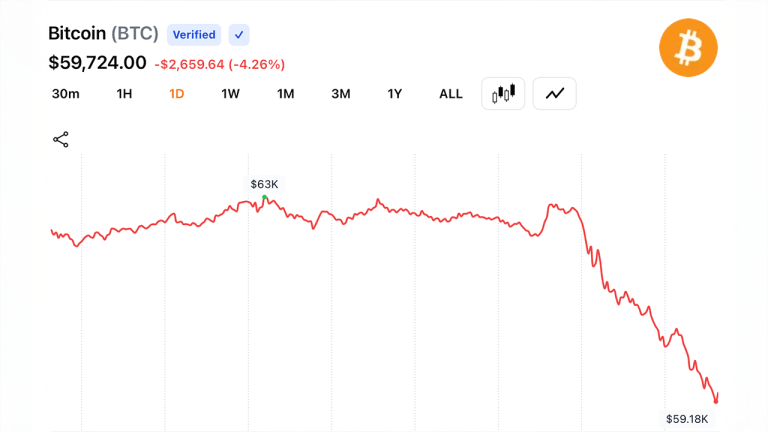
Bitcoin Hits $59,018 After a 5% Drop, Forcing $237M in Long Liquidations
On June 24, bitcoin fell 5% in 24 hours to a new year-to-date low of $59,018. This marks a nearly 10% drop over the week and a 30%+ decline since the start of the year. Bitcoin Hits New YTD Low Below $60K Bitcoin dipped below $60,000 on June 24 amid a marketwide sell-off that saw