Satellite images reveal flooded rail line in Ryanggang province
I analyzed high-resolution satellite imagery of Paekam county, in North Korea’s Ryanggang province, and found that a hydroelectric dam has flooded part of a major North Korea railway line. North Korea responded by building a rerouted track and relocating two train stations to hig
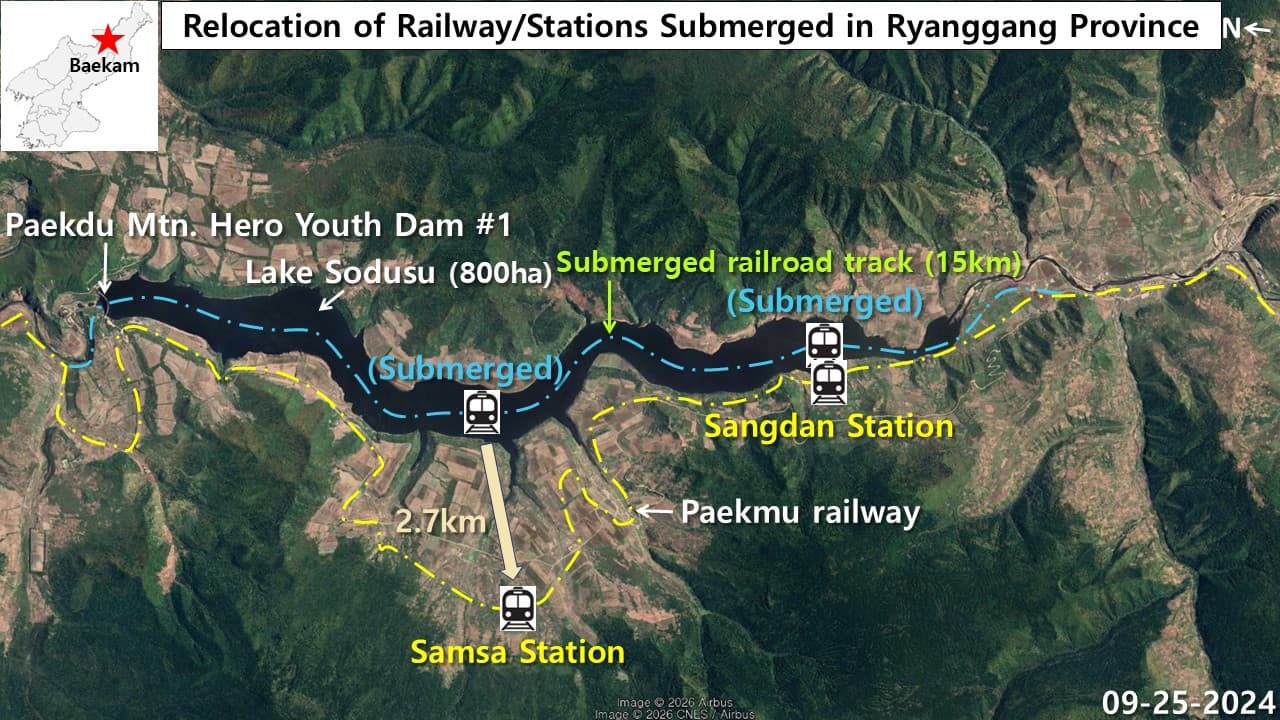
I analyzed high-resolution satellite imagery of Paekam county, in North Korea’s Ryanggang province, and found that a hydroelectric dam has flooded part of a major North Korea railway line. North Korea responded by building a rerouted track and relocating two train stations to higher ground, according to imagery reviewed in 2026. The images show that the Mount Paektu Hero Youth Dam No.
1 created Lake Sodusu, an artificial reservoir spanning roughly 800 hectares. That is about 2.8 times the size of Yeouido, an island in Seoul often used as a size reference in South Korea.
The rising water submerged a 15 kilometer stretch of the Paekmu Line. This narrow gauge railway connects Paekam Cheongnyon Station in Ryanggang province to Musan Station in North Hamgyong province and is used mainly to move iron ore and timber. Two stations along that stretch, Samsa and Sangdan, were also submerged and closed.
To keep trains running, North Korea built a new bypass line. The route climbs along steep mountain slopes and higher ground west of the flooded valley, avoiding the water below. Samsa Station was relocated about 2.
7 kilometers to the west. Sangdan Station was moved only about 200 meters up a nearby slope, reflecting the different terrain each site required. North Korea has poured significant cost and labor into rebuilding rail access through this flooded mountain region.
Its logistics system depends heavily on trains. Poor road conditions and an underdeveloped trucking network mean the country relies on rail to move heavy, bulky goods such as coal, ore and cement over long distances. Rail is estimated to carry about 90% of North Korea’s freight.
That heavy reliance does not mean the rail network is in good condition. Aging tracks and frequent power outages often keep trains from running at full speed. Some sections reportedly move no faster than South Korea’s old slow trains once did.
Still, North Korea chose to cut through mountainous terrain to restore this route. Losing the
Đọc thêm từ Chính trị
Police investigate £500,000 Reform donations from mother of fraudster who backed Farage
George Cottrell’s mother Fiona at the centre of criminal inquiry over potential evasion of restrictions on donationsPolice are investigating donations worth £500,000 made to Reform UK by the mother of a convicted fraudster and ally of Nigel Farage.The investigation concerns two d

Brussels wants action over Trump-Infantino red card controversy
The fight over Folarin Balogun’s suspended one-match ban has sparked new calls for an investigation by a multiparty faction of European lawmakers.

Potential Platner replacements neck-in-neck with Susan Collins in new Maine Senate poll
A new poll testing the strength of potential replacements for Graham Platner (D) in the Maine Senate race found three former gubernatorial candidates polling closely with incumbent Sen. Susan Collins (R-Maine). The statewide survey, first reported by NOTUS, tested head-to-head ma
Burnham’s apology over Gaza marks ‘reset moment’ as Labour seeks to win back progressive voters
But it remains unclear how much of substance will change – and whether it will be enough to rebuild the party’s electoral coalitionOn the final day of Labour’s party conference in 2023, when the public was still reeling from the brutal Hamas attack on Israel just days before, Kei