Sasha’s story: The race to make a treatment for the girl with the ultra-rare disease
Nadine and David Lipworth have devoted their lives to finding treatment that will restore the daughter they knew.
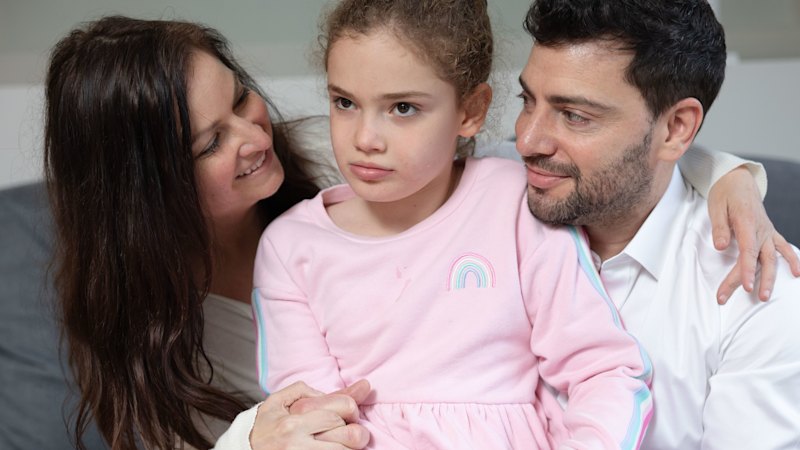
In family videos, Sasha Lipworth beams, open-mouthed and elated as she zooms past on her aquamarine scooter. She giggles as she ambles along a footpath hand-in-hand with her pint-sized friend, and trills “I’m calling mummy” as she presses a comically large telephone receiver to her tiny ear. There’s footage of Sasha sitting on her father’s lap, and singing Happy Birthday before blowing out the four candles on her cake.
Within a few months, an unknown quirk in Sasha’s genetic coding would begin to rob her of the ability to speak, hold a spoon, use a toilet or play with the most basic of baby toys. By the time Sasha was 4½, her ultra-rare disorder had robbed her of every skill she had developed since infancy. She was having hundreds of epileptic seizures each day.
Now nine, Sasha has been nonverbal longer than she was able to speak. For her past five birthdays, she couldn’t blow out a single candle. “That is crazy when you express it like that,” Sasha’s father, David Lipworth, says.
“It’s taking too long to get this done.” David and Sasha’s mother, Nadine Lipworth, have devoted their lives to Sasha – who needs 24-hour care – and to finding a way to restore her abilities and give her the chance to gain new skills. “We were told that there was no treatment and no cure.
That wasn’t going to be an option,” Nadine says. “We knew Sasha before she lost everything, and we wanted to give her her future back.” With no financial backing from any institution, the Lipworths have assembled a crack team of scientists from Australia and the United States to undertake the painstaking work of developing a Sasha-specific genetic therapy.
They are months away from confirming that they have got it: bespoke gene patches called Antisense Oligonucleotides (ASO), the latest frontier in experimental precision therapies for rare genetic disorders that were, until recently, considered “undruggable”. Mini lab-grown Sasha brains are key to the final stages of testing three potential treatment candidates. The team then plans to send the best performer to the US for mandatory safety testing.
If all goes well, Sasha could receive her first dose by her 10th birthday, in March. “To be so close to the finish line is amazing,” David says. “This disease has stolen so much from her, but that spark she has had since she was a baby gives us hope that we can get her back.”
Among the regulatory, logistical and clinical obstacles sits a $1 million hurdle: securing philanthropic donations to cover the cost of toxicology testing in a US laboratory, then, hopefully, manufacturing a new medicine. If the Lipworths succeed, they hope to blaze a trail for other children whose rare genetic diseases could be treated with RNA-targeting precision medicines. “I cannot leave this world until my daughter can tell someone if she is in pain or being harmed,” Nadine says.
Nadine and David Lipworth quit their jobs to care for Sasha and support their mission. David has become a citizen scientist in RNA therapeutics, impressing with his nous internationally renowned molecular biologist and antisense pioneer Professor Emerita Sue Fletcher. Nadine is spearheading crucial fundraising for the expensive endeavour through a GoFundMe page, raffles and tax-deductible donations via the Epilepsy Foundation.
“It has all been up to us,” Nadine says. In March 2024, the University of Sydney’s RNA for Rare Diseases team identified a spontaneous mutation in Sasha’s SLC6A1 gene, which encodes a protein called GAT-1 that recycles the brain’s main calming neurotransmitter, affecting how messages move through the brain. Only one other person in the world is known to have this variant.
In every human cell, there are more than 3 billion base pairs of DNA, each pair a combination of the letters A, T, C and G. “In Sasha’s case, just one letter has been changed, and this is causing her disorder,” Fletcher says. The single-letter change does not alter the protein code in Sasha’s DNA.
It alters how the code is edited, cut and pasted together. When a cell needs to make a protein, it copies the gene containing that protein’s assembly instructions from the master blueprint, DNA, to make a temporary, portable transcription called messenger RNA (mRNA). This transcription needs to be edited before it reaches the cell’s protein-building factory.
The initial unedited message (pre-mRNA) is made up of exons – sequences of the protein-making code – which are separated by non-coding filler sequences called introns. This is where Sasha’s mutation wreaks havoc. The cell’s machinery – cellular scissors and glue – needs to “splice out” the non-coding introns and paste the exon coding sequences together.
Sasha’s single-letter change signals the cellular scissors to splice in the middle of an exon, severing crucial information, rendering it impossible to correctly assemble the protein from the incorrectly edited instructions. “Everything downstream [from the errant splice] is garbled,” Fletcher says. Think of mRNA a
Đọc thêm từ Thế giới

Denmark’s century-old Fourth of July party looks different this year.
Overshadowed by President Trump’s threats to seize Greenland, a Danish territory, the event removed U.S. officials from the program and saw protests arrive.
La favola di Ultimo diventa realtà davanti ai 250mila di Tor Vergata
"Questo è il giorno che aspettavo". Live essenziale e grandioso, indotto da 90 milioni

Canada Has a New Obsession: Soccer
A surprising World Cup run ended on Saturday against Morocco, but the Canadian successes, as a team and a host, are likely to endure.

정유업계 고유가 효과 '소멸'…5월부터 적자전환하기도
(서울=연합뉴스) 조성흠 기자 = 중동 전쟁과 유가 급등에 따른 국내 정유사들의 호실적이 채 1개 분기를 못 넘길 전망이다.