On the Strait of Hormuz, BBC finds seized ships and shark fishermen as uneasy calm returns
The BBC visits Bandar Abbas to see how the US-Israeli war with Iran has affected everyday life in the port city.
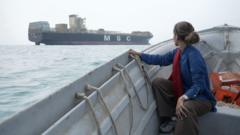
Image source, Jack Garland / BBCImage caption, The Strait of Hormuz has been partially reopened since June as part of the US-Iran ceasefire agreementByNawal Al-MaghafiSenior international investigations correspondent, BBC World Service, Reporting fromBandar Abbas, IranPublished8 minutes agoIt's a sweltering summer's day and fishermen are unloading their catch on the docks.One proudly holds several baby sharks tangled in his nets. Shark sandwich is a local delicacy, he explains.
Another rides off with two large fish strung over his motorbike.In many ways this looks like an ordinary fishing port, but the docks are in Bandar Abbas, an Iranian city on the Strait of Hormuz, one of the world's most vital shipping lanes and a key focal point of the US-Israeli war with Iran.This is the first time international journalists have visited the Iranian side of the strait since the conflict began.
When the US and Israel launched attacks on 28 February, the Iranian regime responded by attacking Israel and neighbouring Gulf states hosting US forces and turned its geography into one of its greatest sources of leverage.Iran's Islamic Revolutionary Guards Corps (IRGC) began firing on commercial ships attempting to go through the strait without its permission, effectively making the waterway impassable.Seafarers from around the world were stranded and oil prices surged, pushing up the cost of energy and fuel, along with a vast range of goods that are shipped around the world.
The US retaliated with a blockade of its own, targeting any ships using Iran's Gulf ports.As a result, these waters have been too dangerous to fish for months. Many fishermen stopped going out, while others continued, knowing they were heading into a battlefield.
Image caption, Fishermen have returned to the waters around Bandar AbbasNow, weeks after Iran allowed the partial reopening of the strait - under a ceasefire agreement with the US that is mostly holding - the sea is calm once more and fishermen are returning.One of them, Abdol Rahman, took the BBC through the strait for a close-up view of how the war has affected life in and around Bandar Abbas.As we sailed through the strait, two container ships seized by the IRGC in April, at the height of the conflict, came into view.
At the time, the IRGC said the vessels had endangered maritime security "by operating without the necessary permits and tampering with navigation systems".Despite the ceasefire, the MSC Francesca and the Epaminondas, which were flagged to Panama and Liberia respectively, have not been released.Dozens of other cargo ships could be seen offshore, waiting for permission from the Iranian authorities to pass through the strait.
As we approached Hormuz Island, 8km (five miles) off the coast of Bandar Abbas, our guide Rahman pointed out an old fortress overlooking the sea.Its weathered red walls are a reminder that control of the strait has been fought over for centuries. Built in the early 16th Century, it was central to the Portuguese Empire's control of this vital waterway - until 1622 when Portugal was driven out by Shah Abbas I of Persia, after whom Bandar Abbas is named.
Image source, Jack Garland / BBCImage caption, Cargo ships are waiting for permission to pass through the Hormuz StraitToday, Bandar Abbas remains just as strategically important. Sitting on Iran's southern coast, close to the narrowest point of the strait, it is home to Iran's Navy and the naval arm of the IRGC.Around a fifth of the world's oil and gas shipments pass through these waters in peacetime, making the city central to the world's economy and key to Iran's military doctrine of "asymmetric warfare" designed to fight more powerful adversaries.
US President Donald Trump has repeatedly threatened an escalation of the conflict, warning that Iran "won't have a country" if it did not reopen the strait.Yet, despite his threats and the ceasefire, Iran has not fully reopened the strait and analysts argue it remains a key point of leverage for Tehran in the ongoing talks to reach a lasting peace agreement between the US and Iran.When the BBC reached Bandar Abbas city, there were signs of life returning to normal.
Families have gone back home, shops have reopened and traffic once again fills the streets.The market, for centuries the place where goods arrive by sea before making their way into southern Iran, is once again bustling.Yet, nearby, the effects of war remain.
On Khushnoodi Street, behind Bandar Abbas's main university, an apartment block is in ruins. It was hit on 26 March by an Israeli strike.Half of the building is standing, while the other half has collapsed into a pile of concrete and twisted metal.
Exposed rooms where families once lived can be seen, and Iranian flags fly from the shattered façade.The building also had some offices and Fatima, a 40-year-old business owner who worked there, was elsewhere at the time of the strike."I knew many of the families who lived here," she said."
There were mothers and child
Đọc thêm từ Thế giới

백악관 “한국 정부, 쿠팡 표적 삼아…불공정 무역 관행 용납 안 해”
본문국제미국·중남미백악관 “한국 정부, 쿠팡 표적 삼아…불공정 무역 관행 용납 안 해”김원철기자수정 2026-07-03 09:54펼침0:00Your browser does not support theaudio element.구글 선호 매체 등록서울 송파구에 있는 쿠팡 본사의 모습.

‘팝의 여왕’ 마돈나는 현재진행형…15번째 정규앨범으로 7년 만에 컴백
본문문화음악·공연·전시‘팝의 여왕’ 마돈나는 현재진행형…15번째 정규앨범으로 7년 만에 컴백이정국기자수정 2026-07-03 10:00펼침0:00Your browser does not support theaudio element.구글 선호 매체 등록3일 ‘컨페션스 투’ 발표마돈나.

최근 추세보단 덜 더웠던 올해 6월…지난해와 ‘극과 극’
본문사회환경최근 추세보단 덜 더웠던 올해 6월…지난해와 ‘극과 극’최원형기자수정 2026-07-03 10:00펼침0:00Your browser does not support theaudio element.구글 선호 매체 등록기상청 6월 기후특성무더운 날씨가 이어진 지난달 29일 서울 광화문광장에서 어린이가 물놀이하며 더위를 식히고 있다.
![[부산소식] 부산시교육청, 이음교육 교사 네트워크 운영](https://img.yna.co.kr/photo/cms/2025/03/06/27/PCM20250306000027990_P2.jpg)
[부산소식] 부산시교육청, 이음교육 교사 네트워크 운영
(부산=연합뉴스) ▲ 부산시교육청은 유치원과 초등학교를 연계하는 이음교육의 경험과 아이디어를 나누며 함께 성장할 수 있도록 '유초연계 이음교육 ...