Nvidia’s Jensen Huang unveils Vera CPU designed for AI agents
Nvidia's strategic expansion into AI CPUs could redefine AI infrastructure, potentially capturing significant market share and boosting revenue. The post Nvidia’s Jensen Huang unveils Vera CPU designed for AI agents appeared first on Crypto Briefing.
Nvidia’s Jensen Huang unveils Vera CPU designed for AI agents The 88-core Arm chip marks Nvidia's aggressive push beyond GPUs and into the CPU territory that powers autonomous AI systems Share Add us on Google by Editorial Team Jun. 15, 2026 Nvidia just told the world it’s not content being the king of GPUs. It wants the CPU crown too, at least when it comes to AI.
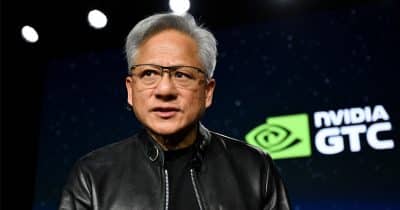
CEO Jensen Huang took the stage at GTC Taipei to introduce the Vera CPU, an 88-core custom Arm-based processor that Nvidia claims is the first chip designed explicitly for agentic AI workloads. Not general computing. Not traditional server tasks.
Specifically the kind of work that autonomous AI agents do: executing code, calling tools, processing data, and making decisions without a human babysitting every step. What Vera actually does differently Nvidia says the Vera CPU handles agentic workloads 1.8 times faster than standard x86 processors, with up to 6x gains on specific metrics.
Advertisement The Vera CPU sits within the broader Vera Rubin platform, which Nvidia introduced earlier in March 2026. That platform bundles Rubin GPUs alongside infrastructure components purpose-built for hyperscale agentic AI deployments. First units have already shipped to some of the biggest names in AI.
OpenAI, Anthropic, and SpaceXAI have all taken delivery, with initial deployments starting in mid-May 2026. Full-scale shipments are expected in the fall. The $200 billion bet on agentic AI Nvidia isn’t making a small wager here.
The company estimates that the agentic AI computing market represents a $200 billion opportunity. And it expects to capture $20 billion in standalone CPU revenue this year alone. The strategic logic is straightforward.
As AI agents proliferate, they need both GPUs for inference and training and CPUs for orchestration, scheduling, and tool execution. By owning both sides of that equation, Nvidia can sell complete platforms rather than individual components. What this means for investors The more immediate investment angle is Nvidia itself.
The company is essentially building the picks and shovels for what it believes will be a $200 billion gold rush. If agentic AI adoption follows the trajectory Nvidia is banking on, the CPU business alone could become a meaningful percentage of the company’s total revenue within a few years. Investors watching the AI infrastructure buildout should track Vera Rubin platform adoption rates closely as full-scale shipments begin this fall, because early traction with tier-one AI labs tends to cascade into broader enterprise adoption within 12 to 18 months.
Disclosure: This article was edited by Editorial Team. For more information on how we create and review content, see our Editorial Policy. AI Nvidia’s Jensen Huang unveils Vera CPU designed for AI agents The 88-core Arm chip marks Nvidia's aggressive push beyond GPUs and into the CPU territory that powers autonomous AI systems by Editorial Team Just now ago Share Add us on Google Nvidia just told the world it’s not content being the king of GPUs.
It wants the CPU crown too, at least when it comes to AI. CEO Jensen Huang took the stage at GTC Taipei to introduce the Vera CPU, an 88-core custom Arm-based processor that Nvidia claims is the first chip designed explicitly for agentic AI workloads. Not general computing.
Not traditional server tasks. Specifically the kind of work that autonomous AI agents do: executing code, calling tools, processing data, and making decisions without a human babysitting every step. What Vera actually does differently Nvidia says the Vera CPU handles agentic workloads 1.
8 times faster than standard x86 processors, with up to 6x gains on specific metrics. Advertisement The Vera CPU sits within the broader Vera Rubin platform, which Nvidia introduced earlier in March 2026. That platform bundles Rubin GPUs alongside infrastructure components purpose-built for hyperscale agentic AI deployments.
First units have already shipped to some of the biggest names in AI. OpenAI, Anthropic, and SpaceXAI have all taken delivery, with initial deployments starting in mid-May 2026. Full-scale shipments are expected in the fall.
The $200 billion bet on agentic AI Nvidia isn’t making a small wager here. The company estimates that the agentic AI computing market represents a $200 billion opportunity. And it expects to capture $20 billion in standalone CPU revenue this year alone.
The strategic logic is straightforward. As AI agents proliferate, they need both GPUs for inference and training and CPUs for orchestration, scheduling, and tool execution. By owning both sides of that equation, Nvidia can sell complete platforms rather than individual components.
What this means for investors The more immediate investment angle is Nvidia itself. The company is essentially building the picks and shovels for what it believes will be a $200 billion gold rush. If agentic AI adoption follows the trajectory Nvidia is banking on, the CPU business alone could bec
Đọc thêm từ Tiền số / Crypto

ChatGPT rolls out pinned chats and projects for better organization
Enhanced organization in ChatGPT fosters productivity and user satisfaction, potentially increasing reliance on AI for complex tasks. The post ChatGPT rolls out pinned chats and projects for better organization appeared first on Crypto Briefing.

US government discusses sanctions relief and $300B reconstruction fund for Iran
The potential easing of sanctions and reconstruction funding for Iran could stabilize regional tensions and impact global oil markets significantly. The post US government discusses sanctions relief and $300B reconstruction fund for Iran appeared first on Crypto Briefing.

Iran agrees to dilute enriched uranium under US supervision as Bitcoin rallies on reduced geopolitical risk
The agreement may stabilize Middle Eastern geopolitics, influencing global markets and regulatory approaches to digital assets and sanctions. The post Iran agrees to dilute enriched uranium under US supervision as Bitcoin rallies on reduced geopolitical risk appeared first on Cry

Tottenham targets Sandro Tonali as top summer signing
Tottenham's pursuit of Tonali highlights the intense competition among top clubs for elite talent, impacting transfer dynamics and market values. The post Tottenham targets Sandro Tonali as top summer signing appeared first on Crypto Briefing.