NASA celebrates America's 250th birthday with red, white and blue snaps of the cosmos — Space photo of the week
NASA's Chandra X-ray Observatory celebrates the 4th of July with a dazzling array of red, white and blue space phenomena.
10Member Features 24/7Access Available 25K+Active Members Exclusive Newsletters Science news direct to your inbox Member Competitions Win exclusive prizes Exclusive Content Premium articles & videos Early Access First to see new features Private Forums Connect with members Monthly Rewards Surprise gifts & perks GET LIVE SCIENCE PLUS It's quick and easy to access Live Science Plus, simply enter your email below. We'll send you a confirmation and sign you up for our daily newsletter, keeping you up to date with the latest science news. Contact me with news and offers from other Future brands By submitting your information you agree to the Terms & Conditions and Privacy Policy and are aged 16 or over.
FIND OUT ABOUT OUR MAGAZINE Want to subscribe to the magazine? Click the button below to find out more information. Find out more 10Member Features 24/7Access Available 25K+Active Members Exclusive Newsletters Science news direct to your inbox Member Competitions Win exclusive prizes Exclusive Content Premium articles & videos Early Access First to see new features Private Forums Connect with members Monthly Rewards Surprise gifts & perks GET LIVE SCIENCE PLUS It's quick and easy to access Live Science Plus, simply enter your email below.
We'll send you a confirmation and sign you up for our daily newsletter, keeping you up to date with the latest science news. Contact me with news and offers from other Future brands By submitting your information you agree to the Terms & Conditions and Privacy Policy and are aged 16 or over. FIND OUT ABOUT OUR MAGAZINE Want to subscribe to the magazine?
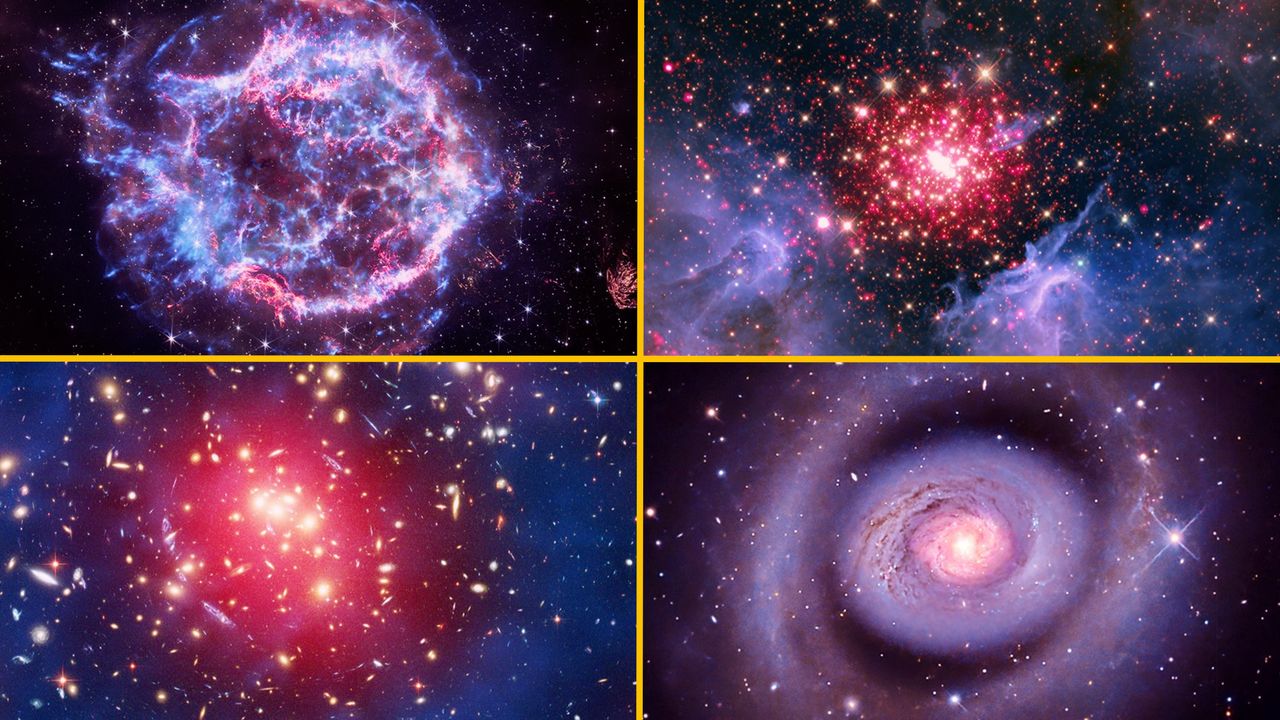
Click the button below to find out more information. Find out more Four Chandra X-ray Observatory images showing (from top left to bottom right) a supernova remnant, a nebula, a galaxy cluster, and a spiral galaxy. (Image credit: X-ray: NASA/CXC/SAO; Optical: Brian Brennan and Remi Lacasse; Optical/IR/UV: NASA/ESA/CSA/STScI/AURA; IR: NASA/ESA/CSA/STScI; Optical and dark matter: NASA/ESA/M.
J. Jee; Image processing: NASA/CXC/SAO/L. Frattare and K.
Arcand) Copy link Facebook X Reddit Pinterest Flipboard Share this article 0 Join the conversation Follow us Add us as a preferred source on Google Newsletter Subscribe to our newsletter quick factsWhat it is: A collection of "red, white and blue" images to celebrate the 250th birthday of the United States.Where it is: Between 11,000 light-years and 19 million light-years from EarthWhen it was shared: June 30, 2026.NASA has marked the 250th birthday of the U.
S. with a striking new collection of cosmic images from its Chandra X-ray Observatory, presenting four deep-space objects in red, white and blue.The image set combines X-ray data from Chandra — which has been orbiting Earth since 1999 — with observations from NASA’s Hubble and James Webb Space Telescopes (JWST), as well as multiple ground-based observatories.
Together, the images showcase some of the universe’s most dramatic environments, from the remains of an exploded star to a massive galaxy cluster shaped by dark matter — each rendered in patriotic colors.Arguably the image most reminiscent of Fourth of July fireworks is that of Cassiopeia A, a famous supernova remnant about 11,000 light-years away in the constellation Cassiopeia (top left). Chandra’s X-ray data, shown in blue and purple, reveal the blast wave from a massive stellar explosion and trace elements such as iron, calcium and oxygen.
Meanwhile, infrared data from JWST has been overlaid in red and white, highlighting the expanding shell of debris and cosmic dust. It’s all the result of a massive star that exploded about 340 years ago, according to NASA.Latest Videos FromWatch full video here: On the top-right is NGC 3603, a giant nebula 20,000 light-years away in the Carina spiral arm of the Milky Way.
Here it appears as a glowing field of highly active, newly formed stars. Chandra’s X-ray observations reveal the light coming from the nebula, while Hubble data in optical, infrared and ultraviolet light show its glittering array of stars, as well as dust and gas. NGC 3603 is the largest nebula seen in visible light in our galaxy.
NGC 4736, also known as M94, is something else entirely. Pictured bottom-right, it’s a spiral galaxy about 19 million light-years from Earth in the constellation Canes Venatici. Its famed for the faint arms outside of its oval-shaped core region — known as a "starburst ring," where new stars are forming.
It’s shown here with Chandra’s X-ray data layered with visible-light imagery captured by ground-based astrophotographers.The final image features ZwCl 0024+1652 (bottom-left), a distant galaxy cluster where Hubble data has helped astronomers infer the presence of dark matter. About five billion light-years away in the constellation Pisces, Chandra’s X-rays reveal a vast reservoir of superheated gas in ZwCl 0024+1652 — shown in red — that contains more mass than the cluster’s galaxies combined.
The release of the new photos also includes novel sonif
Đọc thêm từ Khoa học

Chemical accidents rise as Trump administration proposes weakening safety rules
Chemicals from accidents that injured or killed people increased by nearly 50 percent in recent years.

Spain data on 5.5 million convictions challenges immigration-crime link
When analyzing crime, the foreign population typically shows higher rates than the native population. However, crime statistics change significantly when comparing groups of the same age and gender. A detailed data analysis conducted in a study by the Universidad Carlos III de Ma
The missing 500 million: Cosmic bombardment melted Earth's first crust
The heat of the Hadean may have come from impacts as well as the interior.

Controlling magnetic chirality could help memory pack in more data
Magnetic storage devices, like a computer's hard disk drive, utilize magnets to represent binary data. However, as these devices are downsized, stray magnetic fields generated by individual magnetic components can interact with neighboring elements to cause operational malfunctio