LineShine named world’s fastest supercomputer, surpassing El Capitan after nine-year Chinese absence from top spot
China's supercomputing leap with LineShine may accelerate AI advancements and prompt shifts in global tech strategies and security paradigms. The post LineShine named world’s fastest supercomputer, surpassing El Capitan after nine-year Chinese absence from top spot appeared first
LineShine named world’s fastest supercomputer, surpassing El Capitan after nine-year Chinese absence from top spot China's new machine is the first to exceed 2 exaflops in sustained performance, reclaiming a title it last held in 2017 Share Add us on Google by Editorial Team Jun. 24, 2026 China just broke the supercomputing sound barrier. LineShine, developed by the National Supercomputing Centre in Shenzhen, debuted at No.
1 on the TOP500 list with a sustained performance of 2.198 exaflops on the High Performance Linpack benchmark. That makes it the first system in history to crack the 2-exaflop threshold using only CPUs.
The announcement came at the International Supercomputing Conference in Hamburg, Germany, on June 23, 2026. It dethrones the American-built El Capitan, which had held the crown since late 2024 with its 1.809 exaflops.
For context, LineShine is roughly 21% faster than the machine it replaced. What makes LineShine different Most top-tier supercomputers lean heavily on GPUs to hit their performance numbers. LineShine took a different path entirely, built on an all-CPU architecture using Armv9 LX2 processors.
The system packs 13.79 million cores across 304-core chips running at 1.55 GHz.
Advertisement The machine doesn’t just top the main ranking. It also claimed the No. 1 spot on the High-Performance Conjugate Gradients (HPCG) list with 22.
00 petaflops. On the HPL-MxP list, which measures mixed-precision workloads, it landed fourth with 7.92 exaflops.
Power consumption sits at 42.2 megawatts, giving it an efficiency rating of 52.07 gigaflops per watt.
This is the first time a Chinese supercomputer has topped the TOP500 since Sunway TaihuLight held the crown back in 2017. The geopolitical computing race The US has spent the better part of a decade restricting China’s access to advanced semiconductor technology, particularly high-end chips from companies like Nvidia and AMD. LineShine’s all-CPU design suggests China found a workaround.
Rather than relying on the GPU architectures that dominate Western high-performance computing, the Shenzhen team scaled out with domestically aligned processor technology. Whether the Armv9 LX2 chips were designed entirely in-house or licensed through Arm’s architecture remains a detail worth watching, but the end result speaks for itself. What this means for crypto and AI investors Supercomputers of this caliber are primarily used for scientific simulation, climate modeling, and increasingly, training massive AI models.
The rise of decentralized AI networks, projects that distribute machine learning workloads across blockchain-coordinated infrastructure, depends on the broader trajectory of computing power. There’s also a security dimension that crypto investors shouldn’t ignore. Sustained exaflop-scale computing is a reminder that the cryptographic assumptions underpinning most blockchains aren’t eternal.
Projects investing in post-quantum cryptography may find renewed attention as headlines like this circulate. Disclosure: This article was edited by Editorial Team. For more information on how we create and review content, see our Editorial Policy.
TECHNOLOGY LineShine named world’s fastest supercomputer, surpassing El Capitan after nine-year Chinese absence from top spot China's new machine is the first to exceed 2 exaflops in sustained performance, reclaiming a title it last held in 2017 by Editorial Team Jun. 24, 2026 Share Add us on Google China just broke the supercomputing sound barrier. LineShine, developed by the National Supercomputing Centre in Shenzhen, debuted at No.
1 on the TOP500 list with a sustained performance of 2.198 exaflops on the High Performance Linpack benchmark. That makes it the first system in history to crack the 2-exaflop threshold using only CPUs.
The announcement came at the International Supercomputing Conference in Hamburg, Germany, on June 23, 2026. It dethrones the American-built El Capitan, which had held the crown since late 2024 with its 1.809 exaflops.
For context, LineShine is roughly 21% faster than the machine it replaced. What makes LineShine different Most top-tier supercomputers lean heavily on GPUs to hit their performance numbers. LineShine took a different path entirely, built on an all-CPU architecture using Armv9 LX2 processors.
The system packs 13.79 million cores across 304-core chips running at 1.55 GHz.
Advertisement The machine doesn’t just top the main ranking. It also claimed the No. 1 spot on the High-Performance Conjugate Gradients (HPCG) list with 22.
00 petaflops. On the HPL-MxP list, which measures mixed-precision workloads, it landed fourth with 7.92 exaflops.
Power consumption sits at 42.2 megawatts, giving it an efficiency rating of 52.07 gigaflops per watt.
This is the first time a Chinese supercomputer has topped the TOP500 since Sunway TaihuLight held the crown back in 2017. The geopolitical computing race The US has spent the better part of a decade restricting China’s access to advanced semi
Đọc thêm từ Tiền số / Crypto

HIVE Digital Technologies secures $220M AI GPU cloud contract with Bell Canada and acquires Big Boden data center
HIVE's strategic shift to AI infrastructure and renewable energy positions it for growth, but execution risks and market competition remain challenges. The post HIVE Digital Technologies secures $220M AI GPU cloud contract with Bell Canada and acquires Big Boden data center appea

Standard Chartered Aave Call Puts Institutional DeFi Back On The Table
Standard Chartered Aave Call Puts Institutional DeFi Back On The Table TL;DR Standard Chartered coverage has reportedly put Aave back in the institu
Europe’s crypto licensing race enters final week as MiCA deadline approaches
The race for MiCA approval is intensifying as Europe's crypto industry approaches a key regulatory deadline on July 1.
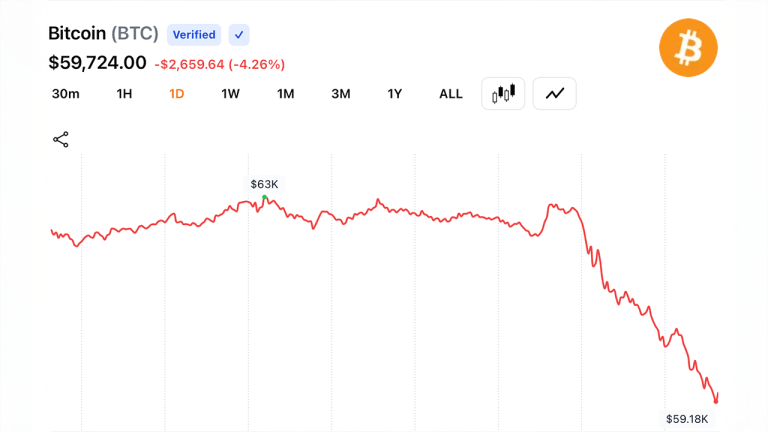
Bitcoin Hits $59,018 After a 5% Drop, Forcing $237M in Long Liquidations
On June 24, bitcoin fell 5% in 24 hours to a new year-to-date low of $59,018. This marks a nearly 10% drop over the week and a 30%+ decline since the start of the year. Bitcoin Hits New YTD Low Below $60K Bitcoin dipped below $60,000 on June 24 amid a marketwide sell-off that saw