Inside Qantas’ plan to turn Australia’s tyranny of distance into profit
Qantas has built a business case for ultra-long direct flights from Sydney to London. Soon it will have the planes to fly them.
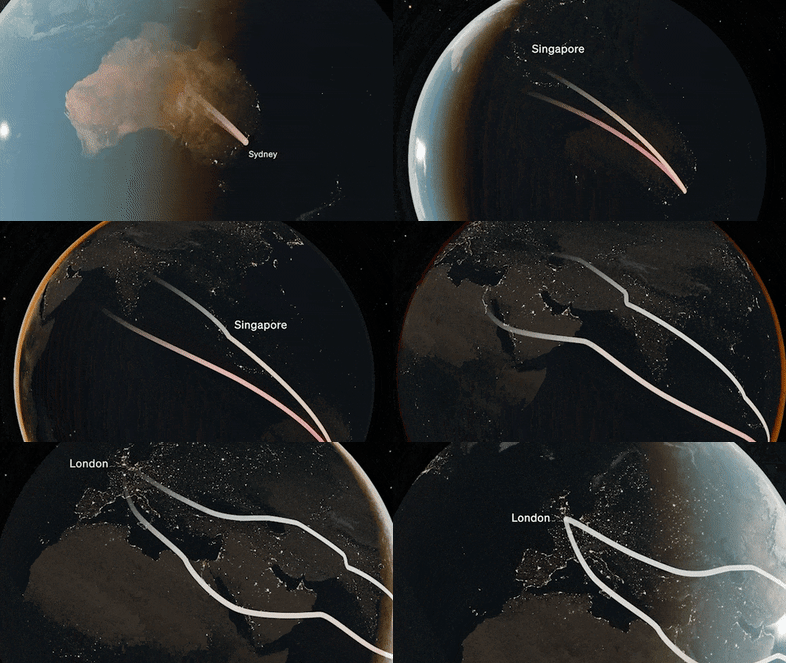
Australians have long struggled with geographic isolation but national carrier Qantas is close to overcoming the country’s “tyranny of distance” and reaping profits for years to come from ultra-long flights travelling from Sydney to London or New York. For the airline’s Project Sunrise solution to work, both customer demand and aircraft supply must keep pace. Qantas expects its long-haul operation to be fully up and running within 2½ years and is forecasting earnings of $400 million annually from a fleet of 12, specially adapted Airbus A350-1000 ULR’s flying from Sydney to London and New York, its CEO Vanessa Hudson says.
The ambitious program is not simply about rolling out a fleet of 12 ultra-long-haul jets which can fly more than 18,000 kilometres, but it’s also taking advantage of Australia’s unique geography which for a long time has been a stumbling block for air carriers. Given the distance and range, planes departing Sydney can fly east or west to arrive at their destinations, a flexibility that takes advantage of seasonal wind patterns that is not available for mid-point carriers in Europe or the United States. “We look around the world and ask who would be the other carriers that would have the business case for the 12 aircraft.
And we can’t see many,” Hudson told a group of journalists invited by the airline to the Airbus factory in Toulouse, France. Nothing about the recent disruptions in aviation stemming from the conflict in the Middle East changes that. It has been a long journey for Qantas and partner Airbus to get to see the first fully produced A350-1000 ULR now eight weeks into testing and certification.
Another has rolled off the assembly line but still needs interior fit-outs and Rolls-Royce engines. The airline announced tickets would go on sale in February 2027 for the first flights to depart from Sydney to London in October of the same year. David Caon, designer of Project Sunrise’s cabins, says they will use mood lighting to subtly mimic sunrise and sunset for the duration of the long flight and described to reporters a pause in the development of the cabin as a “two-year break when we were all on holiday”.
His cheeky description highlights how the pandemic disrupted his design work, and testing and prototyping of cabin seats and suites. Pandemic delays have been much more persistent for the aviation manufacturing sector. In May, Airbus announced that the first A350-1000 ULR, the plane that was adopted for Qantas’ Project Sunrise, would be delayed until next year.
This follows earlier postponements to 2025 and 2026. Airbus agreed to the Qantas project in 2017. An Airbus official confirmed to this masthead the delays in Project Sunrise’s planes were driven by companies and certification processes not controlled by the plane manufacturer.
Even as production in the aircraft industry slows, demand for long-haul flight has zoomed ahead, showing few signs of petering out despite rampant cost-of-living pressures. The desire to travel was supercharged by COVID-19, with both the appetite for flight and the type of flight affected. People want more premium, more international travel.
They are also more willing to blend leisure with work. The Middle East war didn’t dent demand for premium travel either. Instead, passengers – and airlines – cancelled and quickly rerouted away from the region.
If anything, the nature of the disruption supercharged appetite for the kind of travel Project Sunrise will offer. Hudson alluded to the change. “What we have seen from the war is that for a subset of people, we think, there is going to be an increased desire to have point-to-point [travel] and actually fly over the midpoints.”
Some would opt for the service because “they want to get there faster”, others “after the conflict might feel they ... want to avoid any kind of concern or risk”, she said. The plane can fly an extra 1300 kilometres with the help of a 20,000-litre tank fitted into the design.
Before the latest Iran-US ceasefire was announced, Macquarie equities analyst Ian Myles said the recent blowout in Qantas’ fuel bill, estimated to be as high as $800 million, would add to costs that Qantas expected to spend on Project Sunrise and its ambitious fleet refresh. If the Middle East peace held, those fuel costs might be less, Myles said. “Then it’s back to normal” for Qantas, which has reported strong first-half results on the back of rising demand and improved fleet efficiency.
Myles is predicting a “a price war” will break out when the Middle East carriers start to surge back into Australia. On Wednesday, the Australian government relaxed its travel advice for the United Arab Emirates, Qatar, Bahrain, Israel and Kuwait. Qatar Airways is offering up to 10 per cent discount on premium fares worldwide.
Emirates is offering travel insurance to passengers worried about flying through the Gulf region. Qantas is adamant that it’s not competing on price with Middle East carriers. About 70 per cent of Qanta
Đọc thêm từ Thế giới

Robert Irwin and Sam Pang to battle for Gold as Logie nominations announced
This year’s host will battle it out with his predecessor for the top prize, as the ABC and Prime Video dominate the 66th Logie Award nominations.
12 rising musicians advance to ABC Young Performers Awards semi-finals
12 young musicians including pianists, string players, saxophonists and more will compete in the live performance round for the ABC Young Performers Awards in August.

How a U.S. author found — and helped build — community in a Japanese hot spring town
With a new home base, Hanna Kirshner hopes to build even deeper community and cultural connections in rural Ishikawa Prefecture.

Foreigners shocked at Aussie gym habit
Gymgoers have expressed their shock and confusion on Aussies not using lockers in gyms, in a viral video posted online.