How did the Romans build such straight roads?
The Romans have a reputation for building straight roads — but how did they do it?
10Member Features 24/7Access Available 25K+Active Members Exclusive Newsletters Science news direct to your inbox Member Competitions Win exclusive prizes Exclusive Content Premium articles & videos Early Access First to see new features Private Forums Connect with members Monthly Rewards Surprise gifts & perks GET LIVE SCIENCE PLUS It's quick and easy to access Live Science Plus, simply enter your email below. We'll send you a confirmation and sign you up for our daily newsletter, keeping you up to date with the latest science news. Contact me with news and offers from other Future brands By submitting your information you agree to the Terms & Conditions and Privacy Policy and are aged 16 or over.
FIND OUT ABOUT OUR MAGAZINE Want to subscribe to the magazine? Click the button below to find out more information. Find out more 10Member Features 24/7Access Available 25K+Active Members Exclusive Newsletters Science news direct to your inbox Member Competitions Win exclusive prizes Exclusive Content Premium articles & videos Early Access First to see new features Private Forums Connect with members Monthly Rewards Surprise gifts & perks GET LIVE SCIENCE PLUS It's quick and easy to access Live Science Plus, simply enter your email below.
We'll send you a confirmation and sign you up for our daily newsletter, keeping you up to date with the latest science news. Contact me with news and offers from other Future brands By submitting your information you agree to the Terms & Conditions and Privacy Policy and are aged 16 or over. FIND OUT ABOUT OUR MAGAZINE Want to subscribe to the magazine?
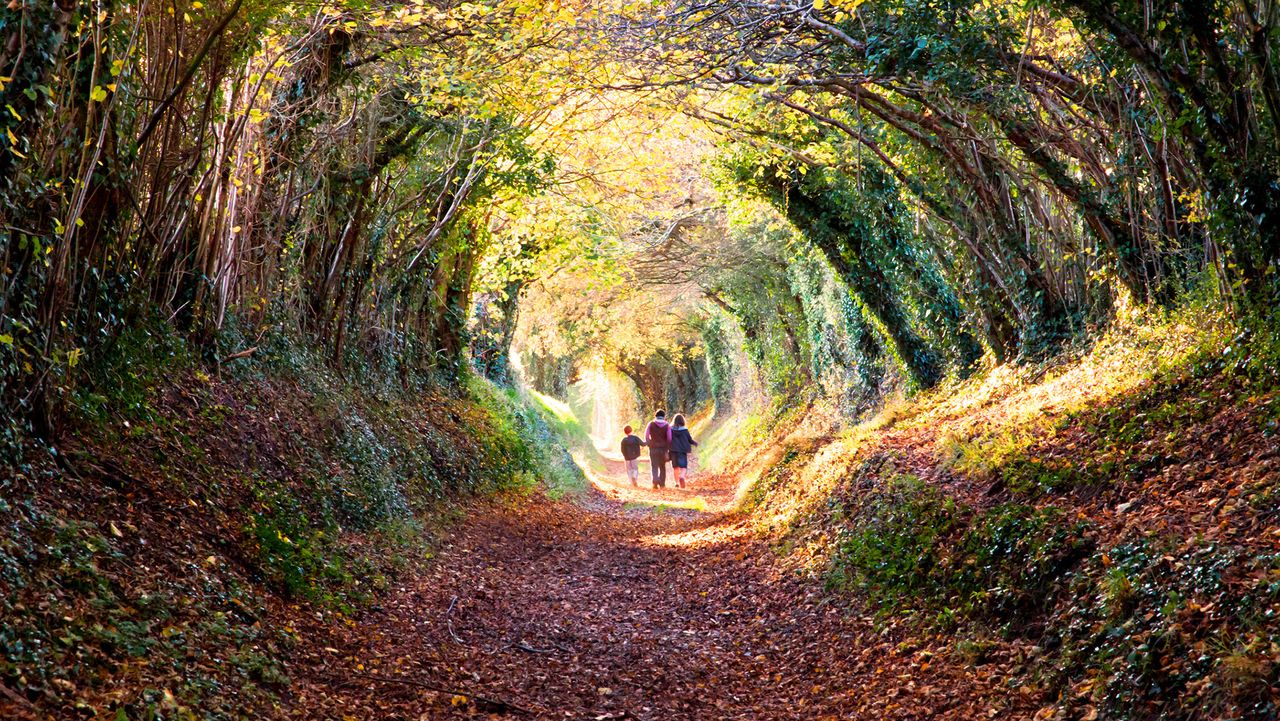
Click the button below to find out more information. Find out more The remarkably straight Stane Street in southern England was built by the Romans. (Image credit: Tim Stocker Photography via Getty Images) Copy link Facebook X Reddit Pinterest Flipboard Share this article 0 Join the conversation Follow us Add us as a preferred source on Google Newsletter Subscribe to our newsletter Ancient Roman transportation engineers built a vast network of roads that stretched across Europe, North Africa and parts of the Middle East.
This complex road system was a key to travel and trade in the Roman Empire, and many of the centuries-old streets had a reputation for being extremely straight, although not all of them were.For instance, Via Appia (Appian Way), which connected Rome to the port of Brundisium in southern Italy, was more than 300 miles (500 kilometers) long, and sizable parts of it were straight. Another Roman road, Stane Street in southern England, was built to connect London to Chichester.
Much of the road, which stretches roughly 57 miles (92 km), is straight. The Middle East also had straight Roman roads, including a coastal avenue from Antioch, Turkey, to what is now Gaza.A recent mapping project was able to map about 186,400 miles (300,000 km) of roads and more are probably undiscovered.
But how did the Romans avoid unnecessary twists and turns to ensure straight streets? The answer may lie in three surveying instruments the Romans used.Surveying roadsIn some instances, the Romans built on top of older roads that existed before they conquered an area.
Their "road network incorporated older roads from a broad range of different societies and polities," Marion Kruse, an associate professor of classics at the University of Cincinnati, told Live Science in an email.But when the Romans built new roads, they used a few different tools to help plan them."Three instruments were used consistently by Roman road builders: the dioptra, the groma, and the chorobatus [or chorobates]," Adriana Panaite, a researcher at the Vasile Pârvan Institute of Archaeology in Romania who has studied Roman roads extensively, told Live Science in an email.
Sign up for our newsletter (Image credit: Marilyn Perkins / Future)Sign up for our weekly Life's Little Mysteries newsletter to get the latest mysteries before they appear online.While the dioptra is known from ancient texts, no example of it has ever been found in an archaeological dig, according to M.J.
T. Lewis, who was a historian at the University of Hull in the U.K.
In his book "Surveying Instruments of Greece and Rome" (Cambridge University Press, 2001), Lewis noted that the design of the dioptra varied considerably. The different designs tended to include a stand and a disc-shaped base with a tube-shaped sighting instrument attached. An ancient surveyor could look through the tube and see a distant object without extraneous light interfering, allowing for a better view.
The chorobatus was used to measure horizontal planes. Around 20 feet (6 meters) long, the chorobatus was a beam of wood on legs and looked like a small table, Lewis wrote. It likely had small weights hanging from it to show that the beam was level.
No ancient example of the chorobatus has survived, and the exact design and way it was used are unclear. Ancient texts indicate that it acted as a builder's level that could help set up l
Đọc thêm từ Khoa học
Science news this week: Life on Mars, weird water and a curious human cousin
June 27, 2026: Our weekly roundup of the latest science in the news, as well as a few fascinating articles to keep you entertained over the weekend.

Amber extreme heat warning extended before cooldown ends record-breaking heatwave
The record-breaking heatwave is set to end with cooler and more unsettled weather by Sunday.

Thawing ground, future questions: Decoding Arctic climate in a lab
In a Penn State lab, a small cylinder of soil sits wired with sensors, slowly cooling as it mimics conditions thousands of miles away.
What's best for baking—butter or margarine? A food scientist explains
Key differences in the chemical structure of butter and margarine mean choosing one or the other has a big effect on your baking