For whom the debt tolls: US default doomsday clock nears midnight. This is why it matters for you
Like an out-of-control spender with a credit card, America’s debt is catching up with her
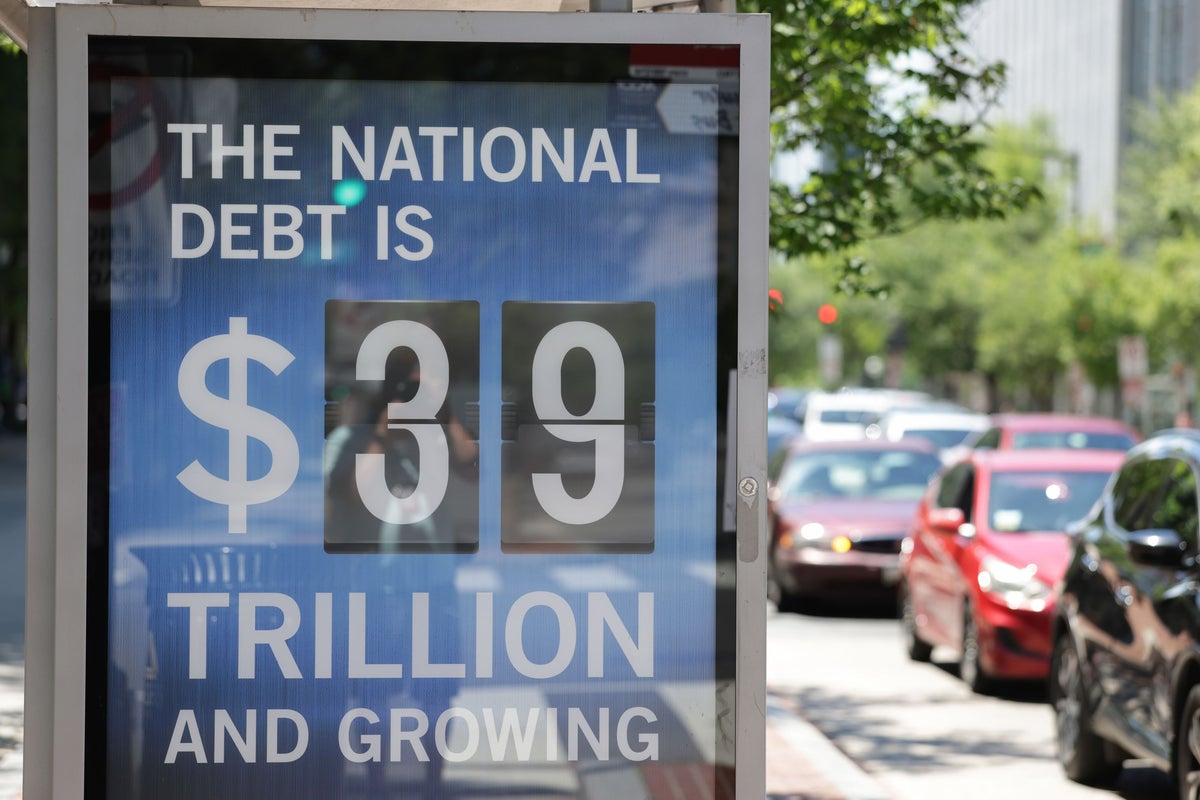
The American economy has a doomsday clock - and it’s ticked even closer to midnight. The “Debt Default Clock” - which measures how close the country is to a financial crisis - is only two economic events away from “doomsday”, a committee of seven economic experts behind the project said this week.The experts said that two events could lead to the U.
S. failing to pay its debts, and trigger a recession or depression. First, the share of debt the U.
S. is using to pay interest hits 70 percent. Second, the government blows through the debt ceiling that limits how much the country can borrow.
“The country is increasingly borrowing simply to pay the interest on what it already owes,” Debt Default Committee Chairman Baker Spring said. “When two-thirds of every new dollar borrowed disappears into interest payments, you are no longer financing the future - you are financing the past. That is the warning this Clock is sounding.”
open image in galleryThe ‘Debt Default Clock’ - which measures how close the country is to a financial crisis - is only two economic events away from ‘doomsday’, a committee of seven economic experts behind the project said this week (Getty)Why it mattersThe “doomsday clock” concept is used in a variety of scenarios - a nuclear version tracks how close the world is to nuclear war, and a climate clock that projects how long the world has until a climate catastrophe and how long we have to take action to stop it.In each case, the closer the hands get to midnight, the closer that human civilization is to some version of a nightmare-ish scenario. If a positive event takes place - say, the U.
S. reduces the interest to pay on its debt - the hands tick backwards.The Debt Default Clock is the closest to its “doomsday scenario” since it was launched in 2019, with U.
S. national debt at $39.1 trillion.
The U.S. government spends its money on a wide range of matters with the Department of Health and Human Services accounting for 26 percent of funding, followed by the Social Security Administration (23 percent), according to the Treasury’s 2025 budget summary.
Spending outpaced funding by $1.8 trillion, bumping up the national debt past $39 trillion.To cover its spending, the government does what most consumers do - borrows money from domestic and foreign sources.
It owes more than $20 trillion to banks, mutual funds, state and local governments, the Federal Reserve, pension funds and other debtors, according to an analysis of 2025 borrowing by the Peter G. Peterson Foundation, a nonpartisan group studying America’s long-term fiscal health. The U.
S. owes around $2 trillion to Japan, China and the United Kingdom, and over $6 trillion to more than 30 other countries, the foundation said.A third of that debt has mounted in the past six years as the country grappled with the pandemic and bursts of inflation.
open image in galleryDebt Default Committee Chairman Baker Spring believes that the United States is one year away from the country’s debt overwhelming Congress and the executive branch (AP)America is aging, and that’s making the country’s budget shortfall worse said Ryan Nunn, director of research at Yale University’s nonpartisan economic think tank The Budget Lab.“Demographic shifts, like the aging of the U.S.
population, also play an important role by putting pressure on major spending programs like Social Security and Medicare,” he said in an email to The Independent. Spring told The Independent the U.S.
economy is on track to enter a fiscal crisis sometime in 2027. Congress and the executive branch will be paralyzed by fear - they’ll want to solve the debt crisis but will be worried that raising taxes will decimate their popularity, Spring believes. “We're saying that if things don't change - if something doesn't change - it will happen,” said Spring, who advised the U.
S. Senate Committee on the Budget.What it means for youA financial crisis would likely last up to one year, Spring said, then the country will plunge into debt default.
If that happens, financial shockwaves would hammer the average consumer.Interest rates would likely skyrocket, said Spring and Daniel Perrin, co-founder of the Debt Default Clock and head of the HSA coalition, a nonprofit that advances legislation for health savings accounts.The Federal Rerve interest rate would rise drastically, Spring said, and that would eventually push up borrowing rates for home loans, credit cards and other products.
Consumers would see mortgage rates jump into double-digits, Perrin said. Credit card rates would likely rise drastically, too, inflating consumer balances. Borrowing would become unaffordable for many consumers.
Over the long term, there are two main ways to solve this kind of debt crisis, Perrin explained.open image in galleryIf America enters a fiscal crisis, there's a good chance that crisis will turn into a recession or depression, Perrin and Spring said (Getty)It falls in two buckets: Raising taxes or cutting programs. Democrats tend
Đọc thêm từ Thế giới

Trump’s DOJ subpoenas New York Times journalists over Qatari-gifted Air Force One report
Trump’s Justice Department subpoenas NY Times journalists over Qatari Air Force One report
Disperso dopo il bagno con i figli nel fiume, trovato senza vita. Un bimbo gravissimo
L'incidente nel Tagliamento a Ronchi di Latisana, l'altro bambino illeso

Preventing NEET-related student casualties is Congress’ priority, says TNCC president Manickam Tagore
The Tamil Nadu Congress Committee president Manickam Tagore on Saturday (July 11, 2026) said his party’s priority was to prevent any further casualties due to National Eligibility Cum Entrance Test (NEET) for UG Medical admissions through intensive campaign, free of politics and

Overnight Russian missile and drone strikes on Ukraine kill six, officials say
Russian attacks on Ukraine killed six people, including a child, and wounded dozens more, according to local officials on Saturday. Moscow launched more than 120 drones and 12 missiles during the night, according to Ukrainian President Volodymyr Zelensky, putting his country's ai