Colourful and fun, this was a night of firsts and lasts
The Australian Ballet is closing out its residency at Regent Theatre with a bubbly and bright work that until now hasn’t been performed outside of New York.
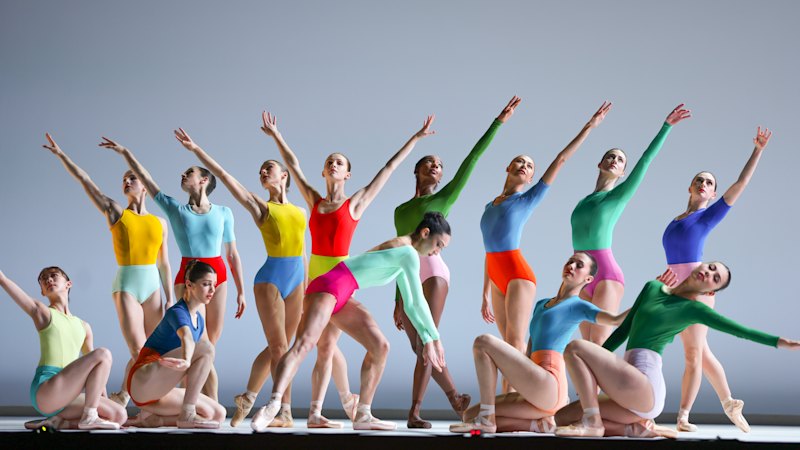
DANCECopland Dance Episodes ★★★★Regent Theatre, until July 2 The opening night of Justin Peck’s Copland Dance Episodes was a night of firsts and lasts. First – this bubbly, plotless ballet has now made its debut outside New York City. And last – it closes The Australian Ballet’s two-and-a-bit-year residency at the Regent Theatre.
I’ll miss the old Regent. From the audience, it has felt like a more than an adequate stopgap. Having ballet in heart of the city – side-by-side with the blockbuster musicals – has elevated the art form’s status, not diminished it.
It has been, in a word, fun. And that’s also the word for Peck’s ballet, set to four of Aaron Copland’s best-known scores: Rodeo, Appalachian Spring, Billy the Kid and Fanfare for the Common Man. Copland was characteristically New York in formation: cosmopolitan, intellectually ambitious.
And Peck, resident choreographer at New York City Ballet, makes this a real New York affair, recalling the formal abstraction of George Balanchine and the urbane theatricality of Jerome Robbins. There is a cute moment early in the show, with the ensemble streaming across the stage. In its coloured costumes and plain background, it recalls Robbins’s Glass Pieces, seen here last year.
A nice detail for Melbourne audiences. The tone is formal, but not austere. It’s as if the dancers are playing around in the studio: pointing, grinning, hiding, making faces.
Then, suddenly, they slip into a perfectly geometrical tableau or a beautifully executed chain of lifts. Much of the pleasure lies in watching Peck enjoy the City Ballet inheritance: a prismatic play of shape and colour, with much coming and going. And plenty of charming detail: street-dance arm balances, cowboy-like leans and neat call-backs.
The ballet flirts with plot, especially in the central duet, danced on opening night by Isobelle Dashwood and Jeremy Hargreaves with a wholesome sort of coquetry. Around them, Samara Merrick and Maxim Zenin dart, while Riley Lapham and Cameron Holmes bring athletic attack. Lapham also joins Benedicte Bemet and Yuumi Yamada in a wonderfully faceted trio, their individuality beautifully showcased.
Peck has a genius for geniality, but his humour does eventually cloy. And his more sombre material is not so engaging. Finally, one of the triumphs of the Regent residency has been how well Orchestra Victoria sounds in the newly expanded pit.
From the dark raptures of Manon and Romeo and Juliet to Copland’s light-filled grandeur, their playing will be one of my fondest memories of this Collins Street interlude. Reviewed by Andrew Fuhrmann DANCESheltering ★★★Bangarra, Arts Centre Melbourne, until June 27 How lucky is Melbourne? In a normal year, we get only one visit from Sydney-based Bangarra Dance Theatre.
Now, a mere three months since we last hosted them – for their spectacular collaboration with Australian Ballet – we get a welcome second visit. The unusualness of this return is echoed in the unusualness of the programme: a triple bill featuring one newish short work, one long older work and a dance film. The highlight, however, is undoubtedly the long work – an almost gothic lament by Frances Rings.
Sheoak (2015) is ostensibly about cultural survival and ancestral connection, but it has a dark, rather gloomy sensibility. The black-and-white costumes in the first part suggest skeletal remains and long grey branches are used to evoke a vast ribcage. The keeper of the scar tree (Chantelle Lee Lockhart) is in mourning.
Her tree has fallen. Around her, the women are lifted by the men and then abruptly dropped – caught at the last moment and held just above the stage. In another scene, male dancers in the ensemble gather in a tight spotlight which gradually dilates.
With their backs bent parallel to the floor, they make sweeping arm gestures before throwing their heads back as if in pain. It gets even darker. The skeleton costumes are changed for black rags with streaks of red that look like wounds.
Cycles of community instability are translated into extravagant expressions of angst, culminating in a frenzied solo by Kassidy Waters. The program’s other two works are by emerging choreographers. The first, Glory Tuohy-Daniell’s Keeping Grounded (2023) – a reflection on the need to return to earth in a tech-frazzled world – is staged around, under and inside a vast net suspended over the stage.
The net recalls Dalisa Pigrum’s Gudirr Gudirr, seen in this same venue at DanceX in 2022. Here, however, it symbolises whatever stops you from being still and grounded. Perhaps it’s also a visual pun on the internet and a life lived always online.
The ensemble draws attention to the most interesting choreographic ideas. This is a company that can make any material seem vivid and full of inspiration. Here we get particularly powerful performances from Roxie Syron and Tamara Bouman.
The film, created by Cass Mortimer Eipper and company dancer Daniel Mateo, is screened between the two live performances. It
Đọc thêm từ Thế giới

'Korea discount' still persists despite chip-driven rallies
KOSPI has risen roughly 144 percent over the past eight months, but the gains have been concentrated in a handful of memory names. The broader market remains substantially undervalued: 68.2 percent of KOSPI constituents trade below book value, against just 1.9 percent for the S&P

Messi, Mbappé romping through World Cup with dazzling display of history-making goals
Lionel Messi has been mesmerizing. Kylian Mbappé has been, well, magnifique. Two of the biggest stars of the World Cup are setting records with history-making goals in a sizzling start that has even the most casual soccer fans in the U.S. taking notice. Messi has five goals in Ar

Seoul turns film center into permanent base camp for young directors
Seoul is betting on student directors to secure the future of its cultural exports. By transforming the Seoul Film Center into a permanent base camp equipped with artificial intelligence (AI) training tools, free workspaces and a massive 23-university film network, municipal auth
Ukraine-Russia war latest: Putin says ‘ready for peace talks’ after Kyiv’s attacks on refinery
Russian president says Moscow ready to end war on terms agreed in Istanbul