Chinese Researchers Train Classical Surrogate Model to Replace Costly Quantum Computers
A team from Henan Key Laboratory of Quantum Information publishes in Nature Communications on a surrogate model that reduces quantum computer calls by 99.98%, making quantum research accessible on ordinary computers.
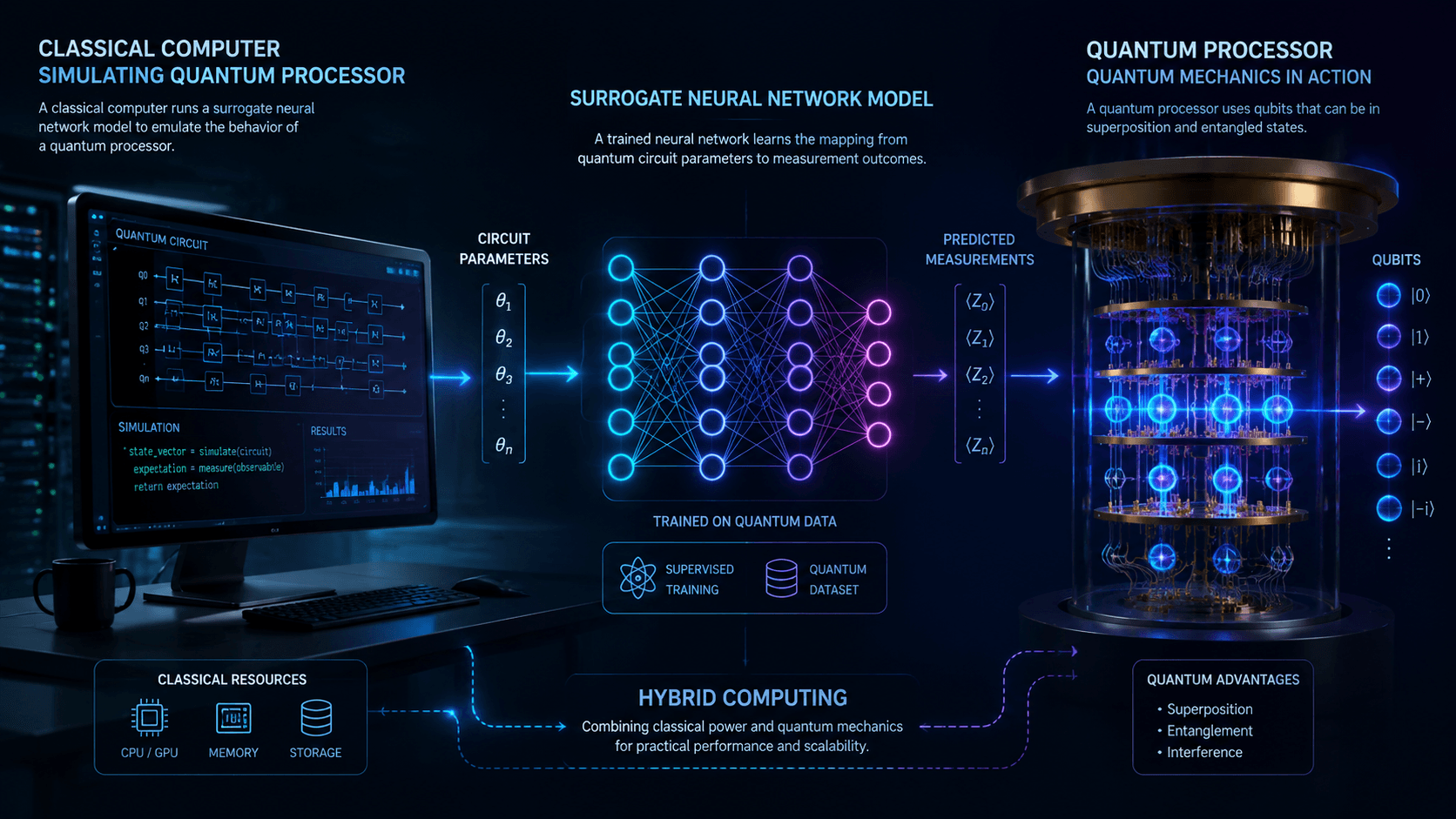
Researchers from the Henan Key Laboratory of Quantum Information and Quantum Cryptography, led by Huang Heliang, have developed an innovative approach to make quantum computing research more accessible: training a classical surrogate model using data from actual quantum processors, then running the majority of computations on ordinary computers. The core challenge is that quantum computers remain extraordinarily expensive. A superconducting quantum system with just tens of qubits costs tens of millions of yuan to build and requires large quantities of liquid helium for cooling.
Even when accessible, the low repetition frequency of quantum processors makes iterative tasks like variational quantum algorithms painfully slow. The team designed two surrogate models: h_cs for circuits with independent parameters and h_qs for circuits with correlated parameters. Both work by training on a small amount of quantum experimental data, after which the classical model learns to predict quantum computer outputs without requiring repeated quantum calls.
In testing on up to 42 superconducting qubits, the surrogate model achieved remarkable results. For a variational quantum eigensolver task, it used only 0.023% of the measurement calls required by traditional methods while finding near-optimal parameters.
Traditional optimization after 100 steps showed an error of 0.21, while the surrogate-pre-trained model achieved an error of 0.09, further refined to 0.
07 after minimal quantum fine-tuning. For a second task identifying Floquet symmetry-protected topological phases — a frontier topic in quantum many-body physics related to Nobel laureate Duncan Haldane's research — the surrogate successfully captured phase transition characteristics across the entire parameter space, closely matching theoretical predictions. The research, published in Nature Communications, builds on the team's years of accumulated expertise.
Huang previously contributed to China's supercomputing application team
Đọc thêm từ Công nghệ

Votre TV connectée rame ou saccade ? 6 réglages pour doper ses performances avant le match
Le Mondial 2026 bat son plein ! Mais entre les ralentissements de l'interface, les applications de streaming (TF1+, M6+, France.tv) qui mettent une éternité à charger, ou l'image qui subit des micro-saccades en plein direct, l'expérience peut vite tourner au cauchemar. Voici comm

Sources: Bain Capital stands to make $15B+ in profits on its 2018 Kioxia buyout, a ~20x return, as Kioxia's stock has surged 5,000%+ since its December 2024 IPO (Financial Times)
Financial Times: Sources: Bain Capital stands to make $15B+ in profits on its 2018 Kioxia buyout, a ~20x return, as Kioxia's stock has surged 5,000%+ since its December 2024 IPO — Bain Capital stands to pocket profits of $15bn on 2018 buyout of Kioxia, the former Toshiba Memory

WWE Night Of Champions Full Card And King Of The Ring Finals
WWE's full Night of Champions 2026 card is set for June 27 in Riyadh, with both King and Queen of the Ring finals and an Undisputed WWE Title triple threat headlining.

Japan’s startup funding, as explained in charts
Knowing where the money flows matters. Take a look at the current fundraising landscape in Japan.