China's 'Cell Factory' Revolution: Synthetic Biology Opens New Frontiers in Biomanufacturing
From artificial starch synthesis using CO2 to AI-powered drug discovery, China's synthetic biology and biomanufacturing sector reaches 1.1 trillion yuan, with cell factories opening limitless possibilities.
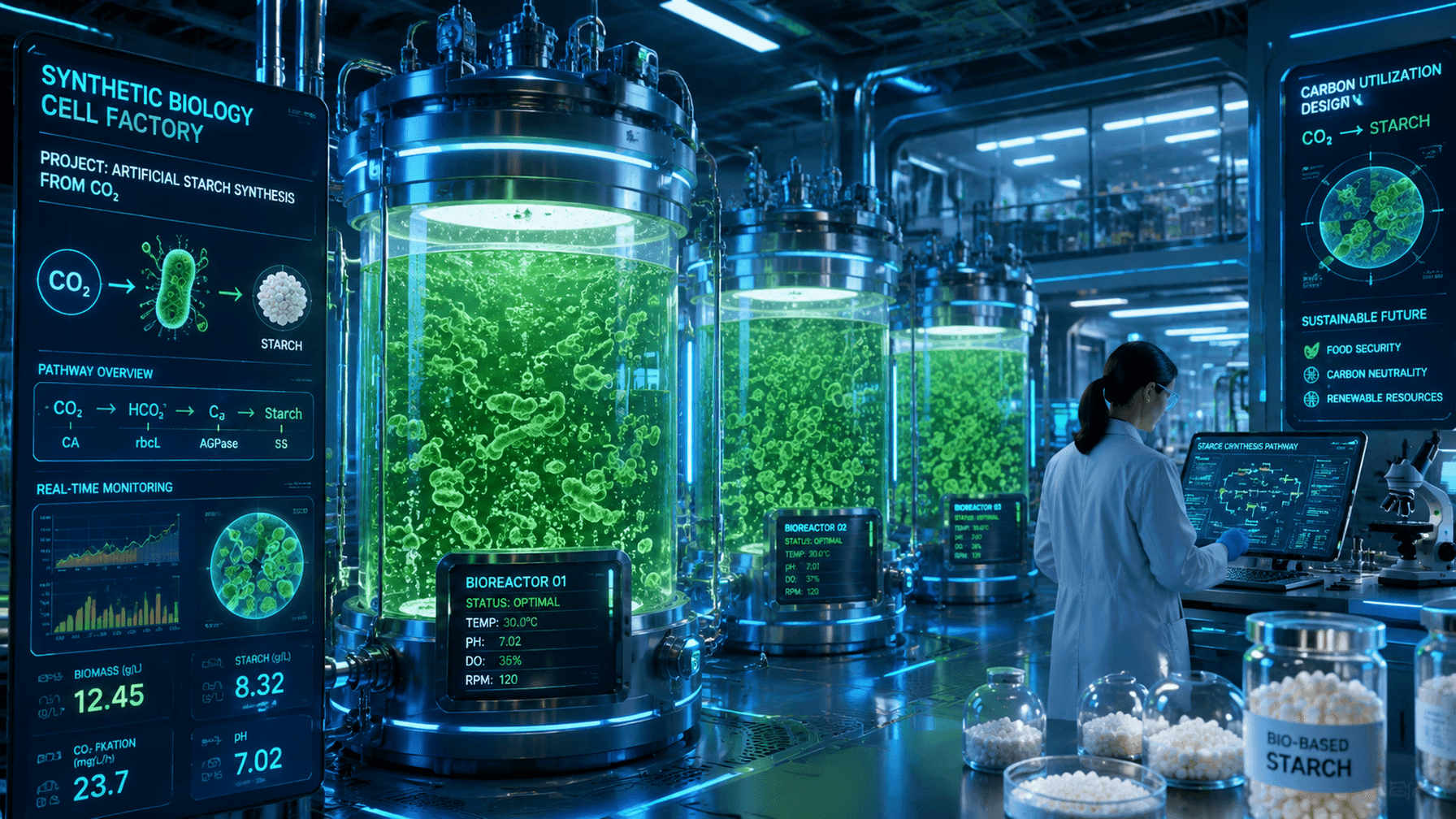
Scientists at the Tianjin Institute of Industrial Biotechnology, Chinese Academy of Sciences, have achieved a breakthrough in artificial starch synthesis, directly converting carbon dioxide into starch and various sugars through a modular "building block" approach that bypasses natural photosynthesis entirely. The achievement, demonstrated during a media tour on June 18, represents a paradigm shift in biomanufacturing. By screening and engineering cells, enzymes, and biological components, researchers can establish "cell factories" capable of mass-producing chemicals, foods, and medicines that were previously dependent on agriculture or petrochemical processes.
According to the Ministry of Industry and Information Technology, China's biomanufacturing sector reached a total scale of 1.1 trillion yuan during the 14th Five-Year Plan period. The 15th Five-Year Plan explicitly identifies biomanufacturing as a priority area for future industry布局.
AI is becoming a powerful accelerator in this field. At Nankai University's State Key Laboratory of Medicinal Chemical Biology, researchers use artificial intelligence to design proteins that do not exist in nature. Professor Guo Yu explained that AI can target-specific protein design significantly accelerates drug development by generating candidates that are then synthesized and experimentally validated.
At the National Modern Chinese Medicine Innovation Center in Tianjin's Binhai New Area, an intelligent traditional Chinese medicine sorting system can identify over 50 herbal varieties with six times the efficiency of manual inspection. The center also operates a shared equipment platform offering services from component analysis to efficacy verification, lowering the R&D threshold for traditional Chinese medicine innovation. Tianjin has emerged as a major hub for biomanufacturing in northern China, hosting institutions including the CAS Tianjin Institute, the National Synthetic Biology Innovation Center, and Tianjin University
Đọc thêm từ Công nghệ

Votre TV connectée rame ou saccade ? 6 réglages pour doper ses performances avant le match
Le Mondial 2026 bat son plein ! Mais entre les ralentissements de l'interface, les applications de streaming (TF1+, M6+, France.tv) qui mettent une éternité à charger, ou l'image qui subit des micro-saccades en plein direct, l'expérience peut vite tourner au cauchemar. Voici comm

Sources: Bain Capital stands to make $15B+ in profits on its 2018 Kioxia buyout, a ~20x return, as Kioxia's stock has surged 5,000%+ since its December 2024 IPO (Financial Times)
Financial Times: Sources: Bain Capital stands to make $15B+ in profits on its 2018 Kioxia buyout, a ~20x return, as Kioxia's stock has surged 5,000%+ since its December 2024 IPO — Bain Capital stands to pocket profits of $15bn on 2018 buyout of Kioxia, the former Toshiba Memory

WWE Night Of Champions Full Card And King Of The Ring Finals
WWE's full Night of Champions 2026 card is set for June 27 in Riyadh, with both King and Queen of the Ring finals and an Undisputed WWE Title triple threat headlining.

Japan’s startup funding, as explained in charts
Knowing where the money flows matters. Take a look at the current fundraising landscape in Japan.