Cardano ratifies van Rossem hard fork, enactment set for July 18
Cardano's decentralized governance milestone enhances resilience and adaptability, potentially boosting ecosystem growth and investor confidence. The post Cardano ratifies van Rossem hard fork, enactment set for July 18 appeared first on Crypto Briefing.
Cardano ratifies van Rossem hard fork, enactment set for July 18 The upgrade marks the first hard fork fully driven by on-chain governance, advancing Cardano to protocol version 11 with cheaper smart contracts and new Plutus features Share Add us on Google by Editorial Team Jul. 14, 2026 Cardano just hit a governance milestone that’s been years in the making. The van Rossem hard fork was ratified on July 13 through the network’s Voltaire on-chain governance framework, with enactment scheduled for July 18.
Here’s why that matters: this is the first Cardano hard fork that wasn’t orchestrated top-down by founding entities like Input Output or the Cardano Foundation. Instead, it was initiated, debated, and ratified entirely through decentralized governance. What the upgrade actually does The van Rossem hard fork advances Cardano to Protocol Version 11, an intra-era change within the Conway ledger era.
New built-in functions are being added to the Plutus smart contract platform, and smart contract execution costs are being reduced. The governance action was first submitted to the mainnet on June 16, during Epoch 637. From submission to ratification took roughly four weeks.
Advertisement The hard fork is named after Max van Rossem, a Cardano community contributor who passed away in early 2026. How the governance process worked The Hard Fork Working Group, led by Intersect MBO, coordinated the technical and procedural logistics. Input Output, the Cardano Foundation, and Emurgo all participated.
Three groups had to sign off: Delegated Representatives (DReps), the Constitutional Committee, and Stake Pool Operators (SPOs). DReps are essentially elected representatives who vote on behalf of ADA holders who delegate their voting power. The Plutus cost model for testnets was ratified with 68.
57% DRep approval by June 13. Before hitting mainnet, the upgrade went through extensive testnet enactments between May and June 2026. Node readiness peaked at approximately 84% by mid-June.
The road to Dijkstra and Leios The van Rossem hard fork is explicitly designed to lay groundwork for the Dijkstra era, Cardano’s next major developmental phase. Dijkstra will bring Leios, a scaling solution that promises to significantly increase Cardano’s throughput. What this means for investors First, the governance precedent.
A blockchain that can upgrade itself through decentralized decision-making is, at least in theory, more resilient and adaptable than one that depends on a small group of core developers. Second, the Plutus cost reductions could matter for ecosystem growth. Lower smart contract costs reduce friction for developers and could help attract applications that previously found Cardano too expensive or cumbersome to build on.
The risk side is equally straightforward. An 84% node readiness figure means roughly 16% of nodes weren’t fully prepared as of mid-June. A 68.
57% approval rate on the Plutus cost model shows the system works, but it also shows that a meaningful minority of DReps dissented, which could signal disagreements that become more consequential on future, more contentious proposals. Disclosure: This article was edited by Editorial Team. For more information on how we create and review content, see our Editorial Policy.
TECHNOLOGY Cardano ratifies van Rossem hard fork, enactment set for July 18 The upgrade marks the first hard fork fully driven by on-chain governance, advancing Cardano to protocol version 11 with cheaper smart contracts and new Plutus features by Editorial Team Jul. 14, 2026 Share Add us on Google Cardano just hit a governance milestone that’s been years in the making. The van Rossem hard fork was ratified on July 13 through the network’s Voltaire on-chain governance framework, with enactment scheduled for July 18.
Here’s why that matters: this is the first Cardano hard fork that wasn’t orchestrated top-down by founding entities like Input Output or the Cardano Foundation. Instead, it was initiated, debated, and ratified entirely through decentralized governance. What the upgrade actually does The van Rossem hard fork advances Cardano to Protocol Version 11, an intra-era change within the Conway ledger era.
New built-in functions are being added to the Plutus smart contract platform, and smart contract execution costs are being reduced. The governance action was first submitted to the mainnet on June 16, during Epoch 637. From submission to ratification took roughly four weeks.
Advertisement The hard fork is named after Max van Rossem, a Cardano community contributor who passed away in early 2026. How the governance process worked The Hard Fork Working Group, led by Intersect MBO, coordinated the technical and procedural logistics. Input Output, the Cardano Foundation, and Emurgo all participated.
Three groups had to sign off: Delegated Representatives (DReps), the Constitutional Committee, and Stake Pool Operators (SPOs). DReps are essentially elected representatives who vote on behalf of ADA holde
Đọc thêm từ Tiền số / Crypto
XRP Boasts 3.13% Market Share: Could It Reach $50 in a $100T Crypto Market?
The XRP community is discussing the token's long-term value based on its current share of the cryptocurrency market. XRP currently accounts for 3.13% of the total crypto market, which stands at $2.15 trillion today.Visit Website

Moscow struggles to sell crude as tanker inventories rise, pressuring global energy markets
Rising tanker inventories highlight Russia's economic vulnerability, potentially destabilizing global oil prices and altering trade dynamics. The post Moscow struggles to sell crude as tanker inventories rise, pressuring global energy markets appeared first on Crypto Briefing.

US-Iran peace talks possible by July 31 amid military tensions
The potential for U.S.-Iran peace talks highlights the fragile balance between diplomatic engagement and military escalation risks. The post US-Iran peace talks possible by July 31 amid military tensions appeared first on Crypto Briefing.
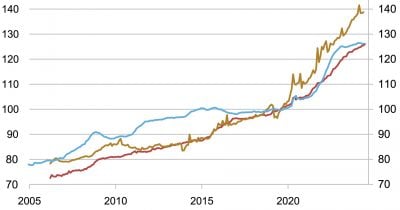
Consumer prices post sharpest decline in six years as inflation cools dramatically in June
Lower inflation may lead to reduced interest rates, boosting liquidity and risk appetite, potentially benefiting crypto and financial markets. The post Consumer prices post sharpest decline in six years as inflation cools dramatically in June appeared first on Crypto Briefing.