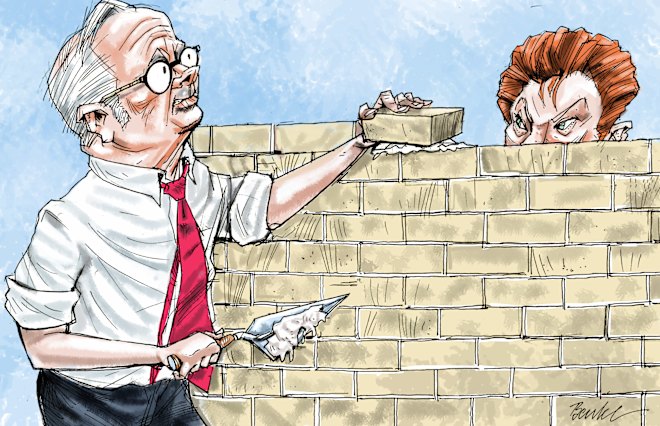
Brick by brick, Albanese is finding faith … that voters will see reason
The PM displays a new optimism – in both the rationality of Australians and his government’s ability to convince them what must change.
June 29, 2026 — 5:00am You have reached your maximum number of saved items. Remove items from your saved list to add more. At this particular moment in history, how much faith do you, personally, retain in people’s rationality?
Overseas, we have seen wild myths take hold – the birther conspiracy around Barack Obama, the insanity of QAnon, the anti-vaccine movement. In Australia, you could add the increasingly popular Hansonian delusions: that by cutting migration and renewables you can magically fix the economic plight of Australians. How big a bet would you be willing to place on facts being an effective challenge to these ideas?
If you are Anthony Albanese, it seems, the answer is: a lot. On Friday, in the aftermath of Labor’s tax changes passing parliament, he predicted scare campaigns would fade in the face of voters’ experience. Grandfathering meant that “anyone who has a negatively geared property will not have that negative gearing change, for example.
And so, they’ll actually see that a whole lot of people think at the moment that they are impacted. They’re not.” His faith in voters’ reason applied to other topics, too.
On renewable energy, the prime minister said on Thursday: “I could recall when the mandatory renewable energy target was 2 per cent ... It’s now providing more than half of Australia’s energy needs. And I think that what …
I really hope happens in a couple of years’ time is that we end the ridiculous debate and nature of some of it.” Albanese’s optimistic mood was understandable. Just occasionally, in politics, it is worth pausing to note the significance of what has just happened.
The passage of Labor’s tax package is one such moment. There are three reasons. First, it restructures our economy.
In Australia, there is something a little unhinged about the way Australians have come to think about the housing market. Our deep reliance on houses to hold and create wealth is increasingly unsettling. Albanese and Treasurer Jim Chalmers have taken a large step towards shifting that.
That has the potential to reshape – both structurally and psychologically – the way our economy works. Second, it begins to tackle the troubling inequality that has crept up on us. Arguably, the government could have gone further, by not grandfathering arrangements.
But grandfathering will not last forever, and ending intergenerational inequality is only part of the point: inequality within generations, too, will lessen over time. The effects are not all immediate – but in the long term they matter. That affects both the structure and the character of this country.
Third, because it signals a shift in the approach of this government. Given the fact Labor has been in power four years and looks likely to govern for another five at least, this may turn out to be historically important. In recent weeks I’ve noted large shifts in the government’s rhetoric: its willingness to acknowledge a broken system after earlier defending it.
There was another shift last week, along similar lines. Early this year, a Labor insider told me they thought it was not quite right to describe this government as focused on consensus – at least not in the way that is usually meant: a government that wants to build consensus. Rather, its approach was to sniff out where consensus already existed, then do that.
So it was interesting to hear the prime minister, last week, offer his own quite different definition. “Consensus does not mean beginning with 100 per cent agreement – or arriving at it. It means listening, negotiating – and moving forward to an outcome.”
Politics is always about bridging different perceptions. A government has a choice: it can move towards the reality that most voters see, or it can convince voters of the reality it sees. A successful government usually manages to do both at once, recognising where voters are while leading them to some other place.
In its first term, the Albanese government tended too much towards the former. Present in each of Albanese’s comments last week is an optimism. We can read this as faith in rationality.
But it can be read, too, as an emerging faith in the ability of his government to convince others to see what it sees. Arguably, taking on the wider changes to capital gains tax – beyond property – was a political error. But it can be seen in another way, too: as a willingness to reach just a little bit further.
The government knew voters recognised a problem in housing. It addressed this and did something voters did not expect, too. Still, it is true the government made some mistakes.
It will have learnt from this experience – and next time, it is likely to be more ready. It will need to be. When a government acts, it not only shifts reality; it shifts people’s expectations of reality.
Here, that applies to two groups. The first is other ministers, who will be acutely conscious both of what Chalmers has achieved and of what Albanese has permitted. They are less likely to be content abiding
Đọc thêm từ Thế giới
OJ Simpson ‘not a fit’ among icons at new Buffalo Bills Stadium
Former star player OJ Simpson will not be recognized at Buffalo Bills new stadium
Trump claims ‘criminally made algae is gone’ from Reflecting Pool
Trump rejoices that the ‘reflecting pool is now in full use’ as he goes on walkabout of DC projects
Rescue teams race against clock to find Venezuela earthquake survivors
More than 2,200 rescue workers from across the world had arrived by Saturday, the United Nations said, and more were still arriving.
Katy Perry forced to cancel festival set hours before performance
Katy Perry festival performance canceled hours before showtime due to extreme weather