Bitcoin Mining Difficulty Set for Steep Drop as Hashrate Slides After Price Crash
Bitcoin’s mining difficulty is on track for the second-largest downward adjustment this year, offering a reprieve to miners after a sharp pullback in network hashrate followed bitcoin’s early June price crash. This article first appeared in The Energy Mag. The original article ca
Bitcoin’s mining difficulty is on track for the second-largest downward adjustment this year, offering a reprieve to miners after a sharp pullback in network hashrate followed bitcoin’s early June price crash. This article first appeared in The Energy Mag. The original article can be viewed here.
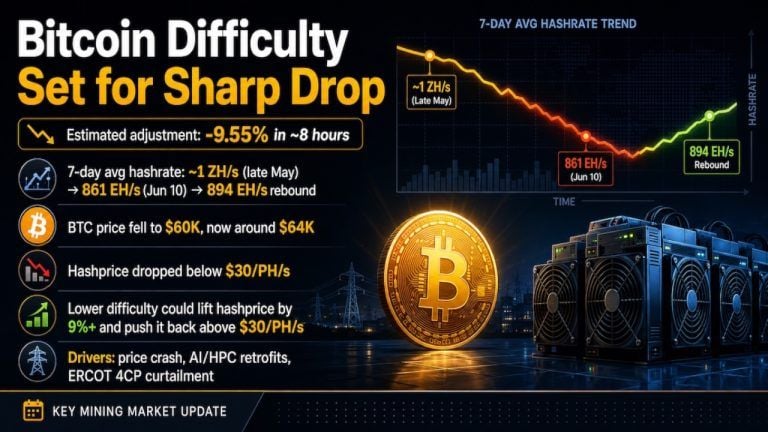
The Energy Mag (formerly The Miner Mag) provides news, data, and insights on the energy–compute–markets nexus. The network’s next difficulty adjustment is currently estimated to fall by about 9.55% in roughly eight hours, according to mining network data.
The decline would reset the amount of computational work required to mine a block lower for the next two-week epoch, lifting the amount of bitcoin that active miners can earn for each unit of hashrate they operate. The expected adjustment follows a sustained drop in bitcoin’s hashrate over the past two weeks. The network’s seven-day moving average hashrate hovered around the 1 zettahash-per-second (ZH/s) mark at the end of May, before falling to roughly 861 EH/s around June 10.
It has since recovered moderately to about 894 EH/s in recent days. The decline came after bitcoin briefly plunged to as low as $60,000 in early June, before rebounding to around $64,000. The selloff pushed hashprice — a measure of daily mining revenue per unit of hashrate — below $30 per petahash per second, renewing pressure on operators with higher power costs or less efficient fleets.
That threshold is important for miners because it pushes more sites closer to, or below, gross breakeven before corporate overhead, debt service and expansion spending. While the most efficient fleets can continue to generate positive margins at lower hashprice levels, older-generation machines and operators with higher electricity costs are more likely to be switched off when revenue falls. The coming difficulty adjustment would partly offset that pressure.
All else being equal, a 9.55% drop in difficulty increases the amount of bitcoin earned per unit of active hashrate by more than 9%, which could lift hashprice back above $30/PH/s if bitcoin’s price and transaction-fee levels remain broadly stable. While part of the hashrate drop appears to be economics-driven, another factor is the continued redeployment of power capacity away from bitcoin mining toward high-performance computing and AI data center workloads.
Several public miners have been unplugging mining rigs or slowing mining growth as they retrofit sites for contracted AI/HPC use, a strategy that can remove bitcoin hashrate even when the underlying power capacity remains in use. Texas may also be contributing to the recent hashrate volatility. The state’s 4CP season began in June, when large power users in ERCOT try to avoid running during the four summer coincident-peak intervals that determine transmission cost allocation for the following year.
For bitcoin miners, the 4CP mechanism creates a strong incentive to curtail during potential monthly peak windows, even when real-time power prices are not especially high. That can temporarily remove significant mining load from the network, particularly because Texas remains one of the largest mining markets in North America. The recent rebound in network hashrate suggests some of the early June reduction may have been a temporary curtailment rather than a permanent shutdown.
This article first appeared in The Energy Mag. The original article can be viewed here. The Energy Mag (formerly The Miner Mag) provides news, data, and insights on the energy–compute–markets nexus.
A Four-Armed Robot for Zero-Gravity Work Could Save $140,000 an Hour SpaceX IPO Is 4x Oversubscribed, But What Happens to the Rest of Market Kalshi Traders Price Fable 5 Return at 68% Before July 1 After Historic AI Ban Iran Denies Sunday Signing as Trump Declares Strait of Hormuz 'Open to All' Tomorrow 40x Claude Max Value Shows Why Heavy Crypto Coders Are Getting a Rare Deal Claude Fable 5 Puts 25% Odds on Bitcoin Reaching $95K by Year-End 2026 Bitcoin Mining Difficulty Set for Steep Drop as Hashrate Slides After Price Crash Rob Hadick Warns Tether and Circle Face Rising Pressure From New Stablecoins A Four-Armed Robot for Zero-Gravity Work Could Save $140,000 an Hour SpaceX IPO Is 4x Oversubscribed, But What Happens to the Rest of Market Pyth Network Targets Bloomberg's $50 Billion Market-Data Empire Bitcoin Mining Difficulty Set for Steep Drop as Hashrate Slides After Price Crash Rob Hadick Warns Tether and Circle Face Rising Pressure From New Stablecoins A Four-Armed Robot for Zero-Gravity Work Could Save $140,000 an Hour SpaceX IPO Is 4x Oversubscribed, But What Happens to the Rest of Market Pyth Network Targets Bloomberg's $50 Billion Market-Data Empire SurgeXRP Presale Accelerates Following XRP Upgrade News, 30% of Soft Cap Filled Before RWA Platform Debut HTX Releases May Performance Report: TradFi Monthly Trading Volume Surpasses $1 Billion, While Multi-Front Progress Rebuilds Ecosystem Confidence Audiera: Why Agent Native
Đọc thêm từ Tiền số / Crypto
Ethereum’s Wall Street Moment: Can ETH Capture Institutional Tokenization Demand?
Broadridge $7.2T DLR volumes and a $34B RWA market put Ethereum in focus as banks test tokenization rails across public and permissioned stacks.
Bitcoin’s 48-hour macro test – Will BOJ, Fed push BTC below $60K?
Crypto heads into a high-volatility macro week as BTC debates bottom formation and risk sentiment weakens.

Self-Custody vs Exchange Custody: Comparing the Real Risks in 2026
Self-custody vs exchange custody in 2026: a balanced risk comparison. Exchange hacks and insolvency versus key-loss and user error, with the data on what users actually do.

New BSP rules put crypto tokens under deeper scrutiny in Philippines
BSP orders stricter crypto listing, monitoring and delisting standards as the Philippines tightens oversight of VASPs.