8,000 pounds of invasive Burmese python removed from the Florida Everglades
Conservationists caught a record-breaking 177 snakes. The post 8,000 pounds of invasive Burmese python removed from the Florida Everglades appeared first on Popular Science.
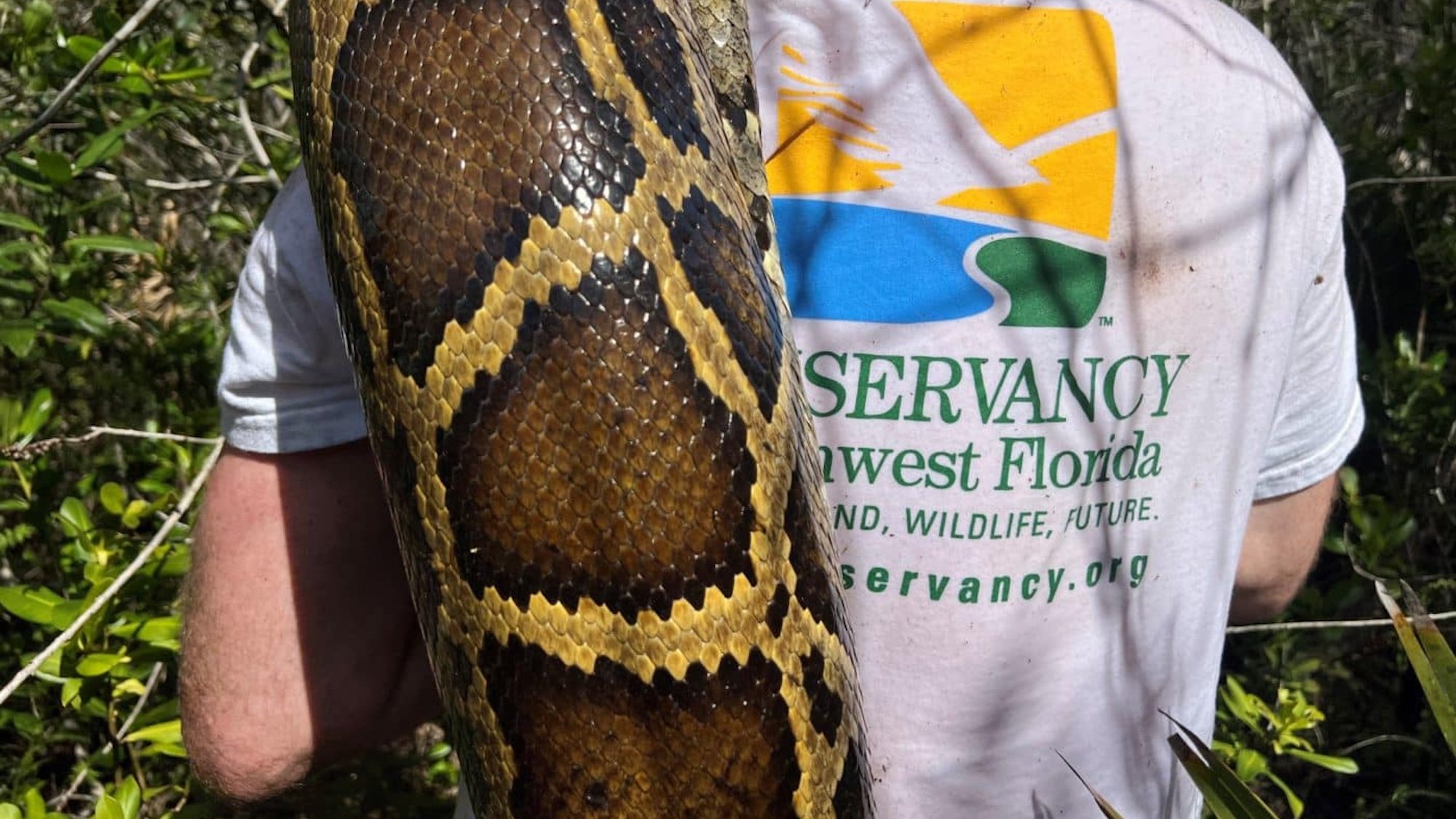
The annual Florida Python Challenge is only a few weeks away, but participants will have trouble matching a new record set earlier this month. Between November 2025 and April 2026, researchers removed 177 apex predators weighing a combined 8,080 pounds from a 200-square-mile area inside Collier County, approximately 90 miles west of Miami. The Conservancy of Southwest Florida announced the results of this most recent effort to cull invasive Burmese pythons (Python bivittatus) from the Everglades, and the tallies far surpassed their previous work.
This achievement marks the organization’s first four-ton removal season. Conservationists used radio telemetry to track 40 previously tagged male pythons dubbed “scout snakes” during their annual mating season. To maximize the population impact, wildlife biologist Ian Bartoszek and colleagues focused on pregnant female pythons, each carrying an average of 70 eggs while weighing an average of 95 pounds.
The season’s largest female python weighed 153 pounds and measured 17 feet long. As a result of their work, researchers estimated around 4,100 unhatched python eggs were taken from the delicate ecosystem. “These science-based management efforts are suppressing local python reproduction.
With continued pressure, we hope to see these removal numbers decline over time,” Bartoszek said in a statement. Burmese pythons first arrived in Florida sometime during the 1970s, likely the result of exotic pet owners illegally releasing them into the Everglades. With a similar climate to their native habitats in southeast Asia (minus any carnivorous competition), the snakes quickly proliferated and rose to the top of the food chain.
Anywhere between 100,000 and 300,000 pythons now live in the subtropical region, causing an immense strain on local wildlife. Around one-in-four of the female pythons caught by the Conservancy contained the remains of white-tailed deer. “Every python removed reduces pressure on the ecosystem,” Conservancy presid
Đọc thêm từ Khoa học

Amazon’s Prime Day deal brings rare deals on HexClad’s high-end cookware
Right now is a great time to replace your aging cookware with HexClad's high-end pots and pans. They're super durable and extremely versatile. The post Amazon’s Prime Day deal brings rare deals on HexClad’s high-end cookware appeared first on Popular Science.
/https://tf-cmsv2-smithsonianmag-media.s3.amazonaws.com/filer_public/10/4e/104e6a77-b931-4071-aee6-84803a2a78d2/swift_spacecraft_update_still-1603854877.jpg)
This Week, NASA Will Launch a First-of-Its-Kind Mission to Save a Space Telescope That Has Observed the Sky for Nearly 22 Years
In 2024, researchers realized that the Neil Gehrels Swift Observatory was falling from its orbit faster than expected. Now, a robotic spacecraft called LINK aims to give the satellite a boost

Rocket Lab launches US Space Force mission with less than 17 hours' notice — a new record
Firefly Aerospace launched the Victus Nox mission for the U.S. Space Force on Thursday night (Sept. 14), just 27 hours after receiving the liftoff order.
How underappreciated mathematician Emmy Noether helped prove physics' most fundamental theories
Noether's work helped prove the conservation of energy in physics, a key foundation for Einstein's theory of relativity