1,200-year-old infant burial found near famous Temple of Artemis in Turkey contains twins — one with an unusual extra rib
The two infants buried in the same Byzantine-era grave may have been twins who died around the time of birth.
Live Science plus Get started to get free access to selected news stories, receive our daily newsletter, post comments, play games and earn badges. JOIN FREE Live Science pro Unlimited access to our exclusive features, expert analysis and in-depth interviews, all ad-free No ads, ever Exclusive, original reporting Scientist interviews and video Member-only features Join live science pro 10Member Features 24/7Access Available 25K+Active Members Exclusive Newsletters Science news direct to your inbox Member Competitions Win exclusive prizes Exclusive Content Premium articles & videos Early Access First to see new features Private Forums Connect with members Monthly Rewards Surprise gifts & perks GET LIVE SCIENCE PLUS It's quick and easy to access Live Science Plus, simply enter your email below. We'll send you a confirmation and sign you up for our daily newsletter, keeping you up to date with the latest science news.
Contact me with news and offers from other Future brands By submitting your information you agree to the Terms & Conditions and Privacy Policy and are aged 16 or over. FIND OUT ABOUT OUR MAGAZINE Want to subscribe to the magazine? Click the button below to find out more information.
Find out more 10Member Features 24/7Access Available 25K+Active Members Exclusive Newsletters Science news direct to your inbox Member Competitions Win exclusive prizes Exclusive Content Premium articles & videos Early Access First to see new features Private Forums Connect with members Monthly Rewards Surprise gifts & perks GET LIVE SCIENCE PLUS It's quick and easy to access Live Science Plus, simply enter your email below. We'll send you a confirmation and sign you up for our daily newsletter, keeping you up to date with the latest science news. Contact me with news and offers from other Future brands By submitting your information you agree to the Terms & Conditions and Privacy Policy and are aged 16 or over.
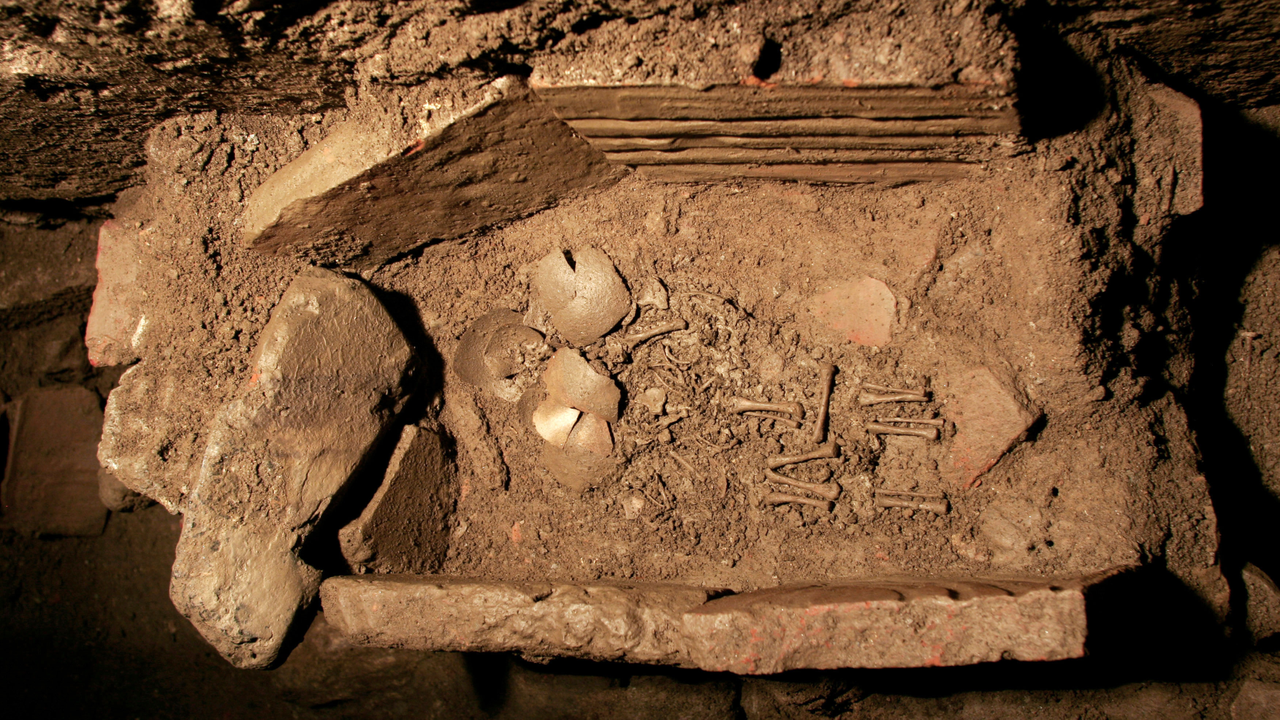
FIND OUT ABOUT OUR MAGAZINE Want to subscribe to the magazine? Click the button below to find out more information. Find out more Two infants were buried in the same tomb in an ancient temple in Turkey.
(Image credit: © OeAW-OeAI/L. Zabrana) Copy link Facebook X Reddit Pinterest Flipboard Share this article 0 Join the conversation Follow us Add us as a preferred source on Google Newsletter Subscribe to our newsletter Archaeologists have uncovered a rare and unusual burial of premature twins in a 1,200-year-old tomb near the Temple of Artemis at Ephesus in Turkey. Although the burial was found in an abandoned latrine, researchers think the intention was to protect the babies in the afterlife."
This interment was made in an unexpected and exceptional setting," Lilli Zabrana, an archaeologist at the Austrian Academy of Sciences who co-authored a new study detailing the discovery, told Live Science in an email. Burials previously discovered at Ephesus were made in a dedicated cemetery outside the boundaries of the ancient temple."What is even more unusual is that the burial contains two premature infants, who were probably twins, which is a rather rare occurrence," study co-author Caroline Partiot, a bioarchaeologist at the Austrian Academy of Sciences, told Live Science in an email.
Evidence of a rare genetic condition found in one of the infants makes the finding even more unique, the researchers noted.Latest Videos FromLive ScienceWatch full video here: In the study, published online July 13 in the journal Childhood in the Past, Partiot and Zabrana analyzed bones found in a tomb that was likely built in the eighth to ninth century, during the middle Byzantine era. The grave was placed within an abandoned latrine channel, originally built during the second or third century, Zabrana said, but the latrine was a later addition to a Roman odeum — a building used for musical performances — that was built in the first century within the sacred area of the famous Temple of Artemis at Ephesus (one of the Seven Wonders of the Ancient World), which was originally built around 550 B.
C. The Romans built a music hall called an odeum at the Temple of Artemis. The infants were found in a tomb in the odeum's latrine.
(Image credit: © OeAW-OeAI/N. Gail)When excavators opened the cist, or stone-lined grave, they saw two tiny skeletons buried side by side. Based primarily on the size of the bones, Partiot and Zabrana estimated the skeletons were from infants who were likely born prematurely at around 33 to 34 gestational weeks, or 7.
5 months in utero. (A full-term pregnancy typically lasts between 39 and 40 weeks.)"The hypothesis that they were twins is based on the fact that they have very similar ages at death and were buried in direct contact with one another," Partiot said.
"However, it will only be possible to confirm whether they were indeed twins through future DNA analyses."Although the researchers did not find any evidence of trauma or disease on the babies' skeletons, they did notice a rare bone called a supernumerary cerv
Đọc thêm từ Khoa học

Il y a 26 ans, l'accident du Concorde
Développé dans les années 60 par les ingénieurs français et britanniques, le Concorde fut un joyau technologique et un échec commercial. Son crash, le 25 juillet 2000 près de Paris, a précipité son retrait de service, trois ans plus tard.

Are BuzzBallz actually recyclable?
BuzzBallz cannot be recycled as the metal lid and plastic body are attached, say experts.

It's the cocktail taking young drinkers by storm - but the packaging is 'unrecyclable'
BuzzBallz cannot be recycled because the metal lid and plastic body are attached, say experts.
/https://tf-cmsv2-smithsonianmag-media.s3.amazonaws.com/filer_public/3d/ed/3dedf986-0087-44f0-9c5a-d7bc444bedec/map.jpg)
Three Millennia Ago, Humans May Have Spoken Thousands More Languages Than We Have Today, During a Linguistic 'Golden Age'
A new study suggests linguistic diversity reached its peak between 1000 B.C.E. and 1000 C.E. before declining